
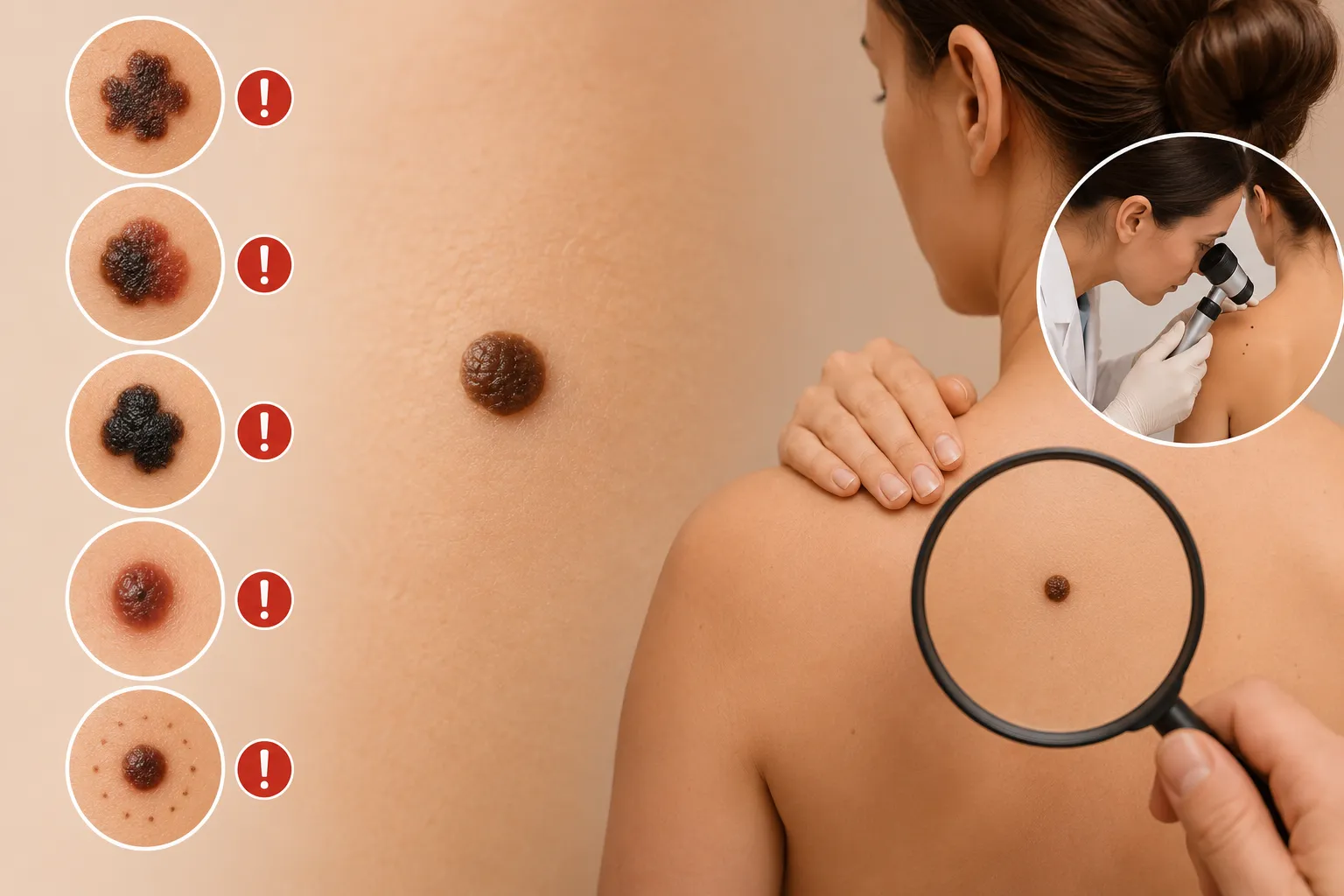
Moles are a normal part of your skin, and most will never cause problems. They sit quietly on your skin, most of them unchanged for years. The trouble is that a small number of them can change over time, and the signs are not always obvious until you know what to look for.
Key Takeaways
- Understand what a mole is: Most moles are harmless clusters of pigment-producing cells that develop during childhood or adolescence and remain unchanged for years.
- Australia faces high skin cancer risk: Australians have one of the highest melanoma rates globally, making regular skin monitoring and early detection essential.
- Use the ABCDE rule: Check moles for Asymmetry, irregular Borders, varied Colour, large Diameter (over 6mm), and Evolution or changes over time.
- Watch for additional warning signs: Itching, bleeding, pain, crusting, new adult-onset growths, or an “ugly duckling” mole should be assessed by a doctor.
- Prioritise regular skin checks: Annual professional skin checks and routine self-examinations help detect melanoma early, improving treatment options and long-term outcomes.
What Counts as a Mole
A mole forms when melanocytes, the pigment-producing cells responsible for your skin’s colour, cluster in one spot rather than distributing evenly across the skin’s surface. The result is a small, defined mark that can appear anywhere on the body, from your face and arms to your back, scalp, and even the soles of your feet.
Most moles are round or oval, measure less than 6mm in diameter, and range in colour from light tan to darker shades of brown. Some appear flat against the skin while others are slightly raised. Neither is inherently a cause for concern.
Moles tend to develop during childhood and the teenage years, with sun exposure playing a significant role in how many appear and how dark they become. The average adult has between 10 and 40 moles, and new ones can continue to form well into adulthood. Most are completely benign.
Why Aussies Need to Take Moles Seriously
Australia ranks among the highest-risk countries for skin cancer in the world, and the statistics support this clearly. Cancer Australia conducted a study that shows around 17,443 new melanoma cases will be diagnosed in 2025, placing the average Australian at a 1 in 19 chance of receiving a melanoma diagnosis by age 85. See what is melanoma and why it’s so serious.
Fortunately, melanoma is highly treatable when detected early. The greater risk lies in leaving changes unexamined, allowing a problem to progress quietly over months or years before it is ever addressed.
How to Use the ABCDE Rule on Your Own Skin
The ABCDE rule gives you a straightforward way to assess your moles between professional appointments. Doctors developed this framework to help identify changes that warrant medical attention. It does not replace a proper skin check, but it is a useful tool for examining your own skin.
- Asymmetry: If one half of the spot looks noticeably different from the other, book an appointment to have it checked by a doctor.
- Border: A normal spot has distinct and smooth edges. You should be alarmed if it has ragged, blurred, or uneven borders.
- Colour: A mole in one consistent shade of brown or tan is generally nothing to worry about. See a specialist if there are mixed colours within the same mole, such as black, red, white, or blue.
- Diameter: Any mole that is larger than 6mm or growing needs professional help.
- Evolution: A mole that changes appearance should be seen by a skin clinic right away.
More Warning Signs Worth Watching For
The ABCDE rule catches a lot of signs, but other symptoms exist that sit beyond what the framework covers.
- An itchy, bleeding, or painful mole, or one that is developing a crusty surface, is sending you a clear warning signal. See I found a suspicious spot for what to do next.
- A mole that looks out of place among the others is what specialists sometimes call the “ugly duckling” sign.
- New growths that appear in adulthood, particularly after age 40, also warrant attention.
Not every new spot is cause for alarm, but a doctor should examine a dark growth that seems to be expanding or shifting. Melanoma can also develop anywhere on the body, including hidden areas such as the buttocks, the soles of the feet, and under the nails.
If you notice anything that does not sit right, whether it fits the ABCDE rule or not, book a consultation with a melanoma specialist.
What to Expect When You Get Checked
A skin check is simpler than most people expect. You can book an appointment at a skin cancer clinic without any prior preparation, and the appointment itself is non-invasive and typically takes around 20 to 30 minutes.
Your doctor will ask about your skin history, new moles or spots you have noticed changing, and your level of sun exposure over the years. From there, they examine your skin from head to toe, noting any spots that look irregular or out of place. Some clinics use a dermatoscope, a small handheld device that magnifies the skin and allows a much closer look than the naked eye alone can provide.
How Regularly You Should Get Checked
For most Australians, a professional skin check once a year is suggested. If you have fair, freckled, or sun-sensitive skin, a history of significant sunburn, or more than 50 moles, more frequent checks are recommended. Ask a specialist to determine how frequently you should schedule assessments.
Examine your own skin regularly between professional appointments. Use a mirror to check areas that are difficult to see on your own, or you may ask someone to help.
Early Detection Is the Real Game-Changer
Identifying a problem at its earliest stage means more treatment options, faster recovery, and significantly better outcomes. The sooner you act, the higher your chances of surviving skin cancer. This matters because some skin cancers don’t look dangerous at first glance.
In 2024, the Australian Institute of Health and Welfare noted that the Federal Government allocated $10.3 million to establish a national targeted skin cancer screening programme, reflecting the health system’s serious approach to this issue. That level of investment signals just how seriously skin cancer is taken as a public health priority in Australia.
Check Your Skin Before It Becomes a Bigger Problem
Most moles are completely harmless, but knowing what is normal with your skin and noticing when something changes are among the simplest things you can do for your long-term health. Pay attention if a mole looks or feels different. If it has already changed, book a skin check immediately.
Your skin works hard to protect you every day. Return the favour by looking after it.
