
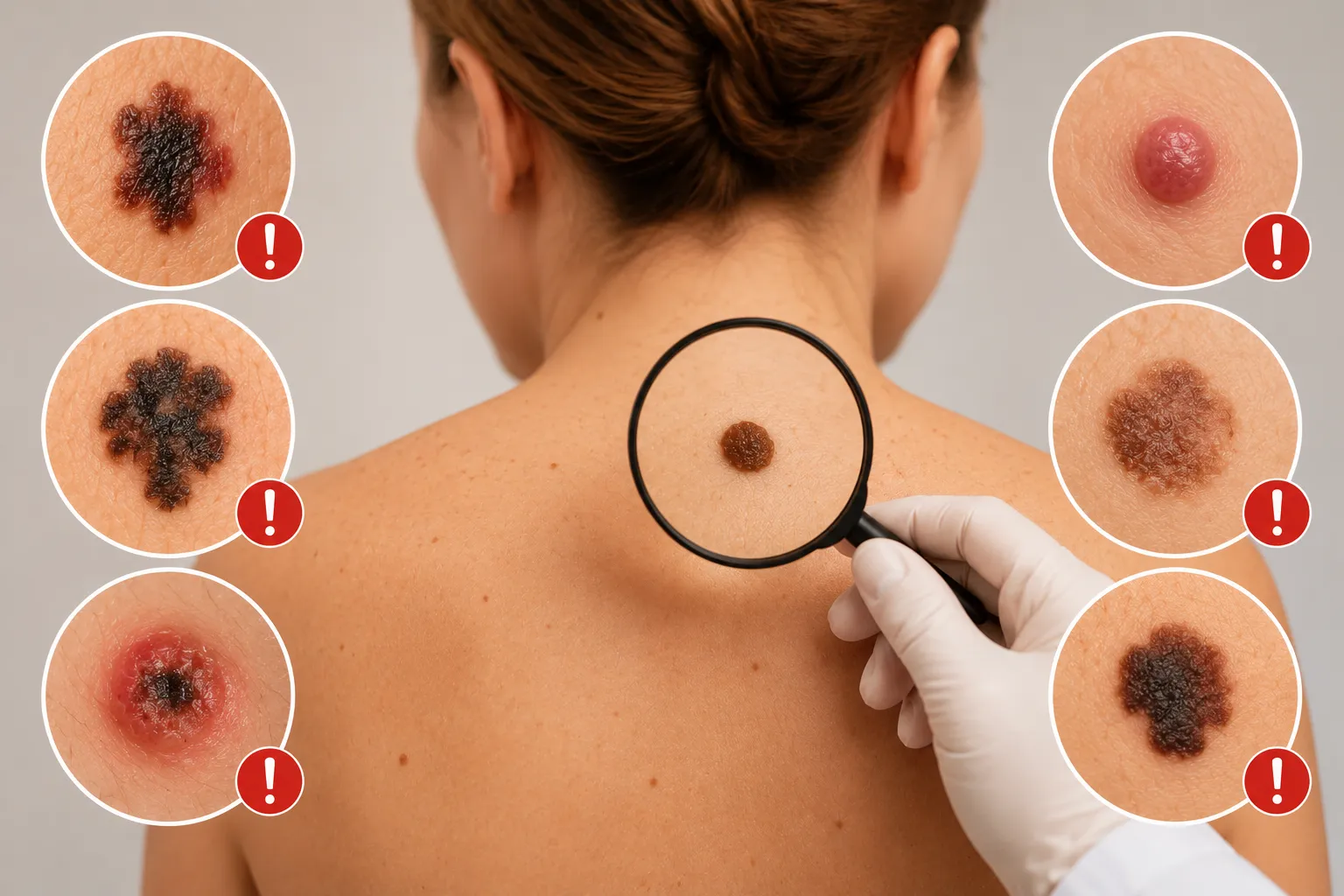
Australia has one of the highest rates of skin cancer in the world, yet many of the earliest warning signs go unnoticed for months. Around two in three Australians will be diagnosed with skin cancer during their lifetime, but skin cancer caught early is far more treatable than skin cancer caught late.
The problem is that most people are waiting for something that looks obviously wrong. Skin cancer does not always play by those rules. Here are the early signs of skin cancer you should never ignore and what each one actually looks like.
Key Takeaways
- Understand what a mole is: Most moles are harmless clusters of pigment-producing cells that develop during childhood or adolescence and remain unchanged for years.
- Australia faces high skin cancer risk: Australians have one of the highest melanoma rates globally, making regular skin monitoring and early detection essential.
- Use the ABCDE rule: Check moles for Asymmetry, irregular Borders, varied Colour, large Diameter, and Evolution or changes over time.
- Watch for additional warning signs: Itching, bleeding, pain, crusting, new adult-onset growths, or an “ugly duckling” mole should be assessed by a doctor.
- Prioritise regular skin checks: Annual professional skin checks and routine self-examinations help detect melanoma early, improving treatment options and long-term outcomes.
A New Spot Shows Up Out of Nowhere
Skin changes constantly. New spots, moles, and lesions appear throughout life, and most of them are completely harmless.
New moles in childhood are common and generally unremarkable, but a new lesion that appears in adulthood and continues to develop should be assessed by a medical professional. If a spot that was not there a few months ago is still there now and looks different, do not wait.
A Mole That’s Changing
A mole that changes over time is one of the most well-known early indicators of melanoma, the form of skin cancer with the highest risk. See how rapidly melanoma progresses for more context. Doctors use the ABCDE rule as a guide to identifying suspicious moles. It covers five specific changes worth watching for.
- Asymmetry: Some parts of the mole do not correspond with others.
- Border: The outline is uneven, notched, or poorly defined.
- Colour: More than one shade appears within the same lesion.
- Diameter: The spot exceeds approximately 6mm, though smaller lesions can still be significant.
- Evolving: The mole looks or feels different from one month to the next.
If you spot any mole that scores even one of these criteria, consult a melanoma specialist as soon as possible.
A Spot Just Won’t Go Away
Healthy skin heals. A minor graze, a pimple, or a small cut will typically resolve within a couple of weeks. When a skin lesion continues to scab, bleeds or reopen, and repeats the cycle without any sign of genuine healing, that pattern is worth taking seriously.
Basal cell carcinoma and squamous cell carcinoma both commonly present this way, and both are frequently mistaken for ordinary skin irritations. People tend to assume a slow-healing spot is a reaction to something topical or an insect bite that has become infected.
A Lesion That Bleeds or Scabs Repeatedly
Some skin cancers develop in a way that destabilises the overlying skin tissue. A lesion that bleeds easily or crusts repeatedly should be checked immediately. These signs are particularly significant when they appear on body parts prone to sun exposure, such as the face, ears, scalp, neck, forearms, and the backs of the hands.
The Discomfort You Shouldn’t Brush Off
Visual changes are not the only signal to pay attention to. Some skin cancers can also be felt as a persistent itch, a tenderness, or aching sensation without any injury.
This surprises many people, who assume skin cancer is a condition that looks abnormal long before it feels abnormal. If a patch of skin starts to feel consistently different from the surrounding tissue, that sensation alone is worth bringing up with a professional.
When a Bump Looks Waxy or Translucent
Among the most commonly missed presentations of skin cancer is the shiny, skin-coloured, or faintly pink bump that characterises many basal cell carcinomas.
These lesions do not match the mental image most people know of skin cancer. They can appear almost translucent, with a smooth, waxy surface and a faint, rolled border.
When Dry, Flaky Skin Doesn’t Improve
Skin cancer does not always start as a spot or a lump. For some, the first sign is a patch of skin that feels rough, looks slightly red or pink, and refuses to respond to moisturiser or topical treatment the way ordinary dry skin would.
These patches may flake, become mildly tender, and keep returning in the same location. Actinic keratoses fall into this category and are relevant because, without treatment, they carry a risk of progressing to squamous cell carcinoma.
Apply the Ugly Duckling Rule to Spots That Stand Out
The lesion that draws attention is the one that does not belong to that group. Clinicians refer to this as the ugly duckling sign.
In this case, you do not need to meet the ABCDE criteria to justify a spot for inspection. If one spot on your body is different from others, it is a valid reason to seek an assessment.
The Nail Changes Linked to Melanoma
The area beneath a fingernail or toenail is not a location most people think to examine when checking their skin, but melanoma can and does develop there. A dark longitudinal stripe running along the nail bed, pigmentation spreading onto the skin under the nails, or splitting or thickening of the nail plate are all signs that require medical attention.
Some will link it to past injury or bruising. Consulting a professional would be the best option if the discolouration worsens over time.
Catch Skin Cancer Early for Better Outcomes
The relationship between detection timing and treatment complexity is well established. Skin cancers identified at an early stage are generally smaller, more contained, and more responsive to treatment.
As a lesion progresses, treatment tends to become more involved, and the range of options available can narrow. Routine skin checks are a proactive measure that allow doctors to identify changes before they reach a point where intervention becomes more demanding.
Take Your Skin’s Warning Signs Seriously
The signs of skin cancer are often gradual, mild, and easy to rationalise away. The most reliable thing you can do for your skin health is to act as early as possible. If you have at least one of the signs, book a consultation at a trusted skin cancer clinic rather than wait for certainty that may come too late. See how to prepare for a check, and if you’ve been relying on an app for peace of mind, see skin cancer apps be trusted.
