
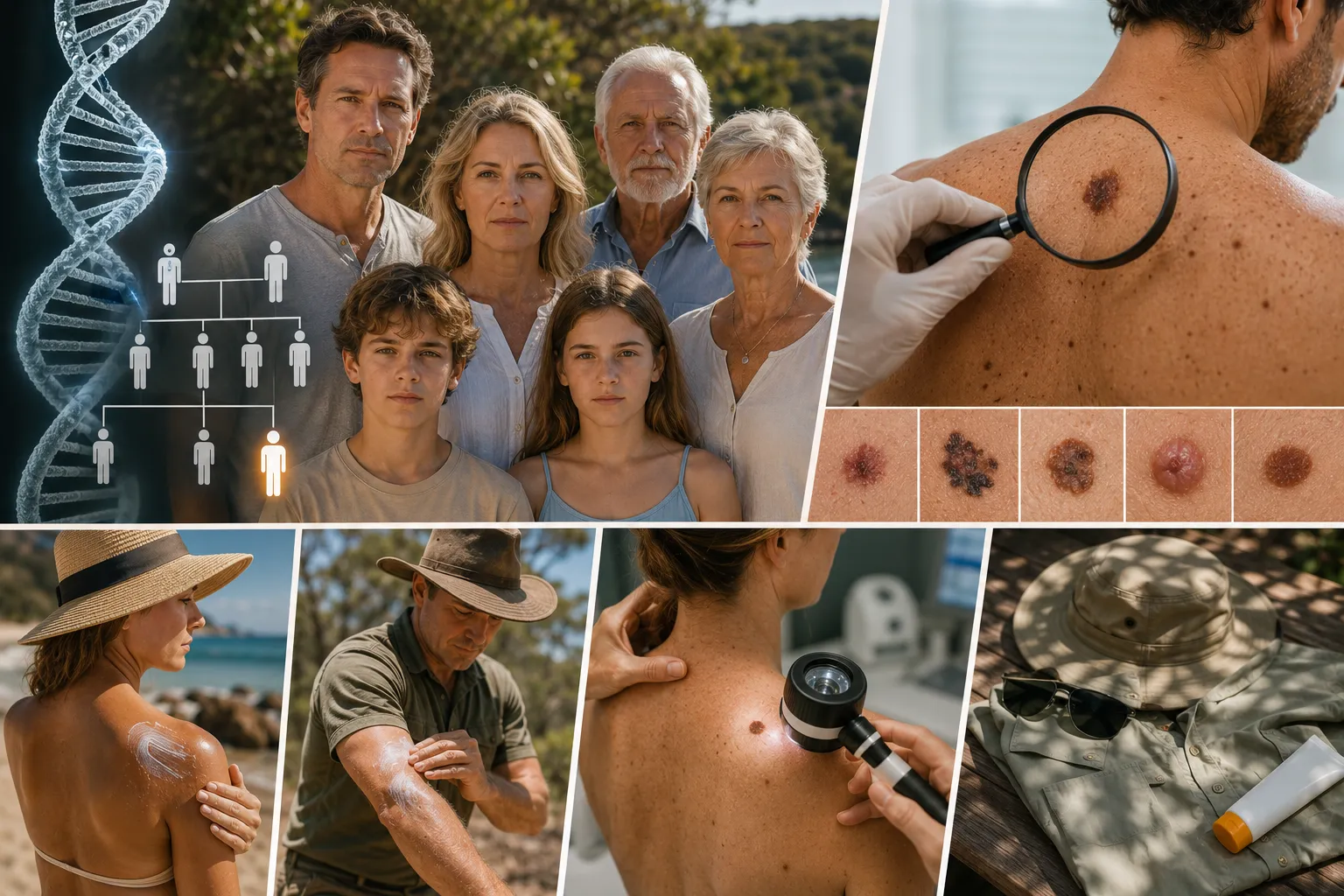
Someone in your family has had a skin cancer cut out, and now every freckle on your own back feels like a question mark. Perhaps it was your dad or an aunt who spent every summer of the 1970s at the beach without a hat. Whoever it was, the worry that follows is the same, and it usually arrives with no clear sense of how worried you should actually be.
Key Takeaways
- Family history can increase melanoma risk, with a first-degree relative diagnosed with melanoma associated with roughly 1.7 times the relative risk.
- Genes are only part of the picture, with fair skin, light hair or eyes, numerous moles, and childhood sunburns also contributing to overall risk.
- A high mole count is an important risk factor, particularly having more than 100 moles or developing new moles during adulthood.
- Sun protection and regular self-checks are essential, helping reduce UV exposure and identify changes that may require professional assessment.
- Skin check frequency should match your risk profile, with people who have family history and other risk factors potentially benefiting from more frequent professional examinations.
How Much Does Family History Actually Raise Your Risk?
The number worth holding onto is 1.7, which is where a first-degree relative with melanoma puts your relative risk, and it falls well short of the odds most people picture after a family diagnosis. Your skin type, your mole count and how much sun you copped as a kid all sit alongside it, and in combination they say more than the family link does on its own.
A family history of melanoma in a first-degree relative, meaning a parent, sibling, or child, carries a relative risk of 1.7, which puts your risk at close to double that of someone without that history, according to Cancer Council Australia. Around 5% to 10% of melanoma cases occur in families with a genuine hereditary predisposition rather than a pattern explained purely by shared sun exposure.
Doctors do separate the two, though the line between them is blurrier than it sounds. Roughly 5% to 10% of melanomas show up in families with a real hereditary predisposition, so the large majority of family clusters come down to something less dramatic than a faulty gene.
Fair skin gets handed around a family much as a surname does, and the habits travel with it, including all those long unshaded afternoons that nobody thought twice about at the time.
Genes Are Only Part of the Picture
Family history rarely operates alone. Several other traits tend to travel together through families and compound the risk further:
- Fair skin that burns rather than tans
- Red or light-coloured hair
- Light-coloured eyes
- A high number of moles, particularly more than 100
- A history of blistering sunburns, especially in childhood
If several of these apply to you alongside a family history of skin cancer, your overall risk profile climbs higher again. That is useful information rather than alarming information because it tells you how proactive to be.
What Your Mole Count Tells You
Count your moles sometime. It sounds like an odd way to spend ten minutes, but mole count turns out to be one of the sharper predictors of melanoma risk going around, and it is the one most people never think to check.
Pooled international research cited by Cancer Council Australia puts the risk for someone with 101 to 120 moles at almost seven times that of someone with very few. That is a bigger jump than family history delivers on its own, which is worth knowing if you have always been the one in the family covered in them.
Two patterns are worth raising with a melanoma specialist. The first is having always had a lot of moles, and the second is noticing new ones appearing in adulthood. Both are reasons to mention your mole count at your next skin check rather than assuming someone will spot the pattern on their own.
How to Act on What You Know
None of this calls for a magnifying glass and a weekly audit of your own back. Four habits do most of the work here, and they are the ones worth locking in early:
- Know your own skin. Most people could not describe what is on their own shoulder blade, let alone notice it changing.
- Take sun protection seriously. UV levels in Australia stay high enough to burn through most of the year, including on grey days.
- Get checked regularly. Self-checks are useful for spotting change, though they miss the areas you cannot see and the ones that look harmless to an untrained eye.
- Tell your clinician about your family history. That single detail changes how thoroughly a clinician looks and how soon they ask you back.
Set a Check-Up Schedule That Fits Your Risk
A standard once-a-year check may not suit someone with a family history of skin cancer. Your clinician might recommend more frequent visits, particularly if you also have fair skin, a high mole count, or a personal history of unusual spots. Raise your family history when you book rather than waiting for someone to ask.
Locals have it easier here than most. Book in with a trusted skin cancer clinic and you get to sit down with someone who will ask about your family before deciding how often to see you, rather than handing over the standard twelve-month line.
A proper skin cancer check means the whole body, head to feet, including the parts you have no hope of inspecting yourself. Most of the value builds up over the years because the same clinician can compare this visit against the last one and pick up anything that has shifted.
Frequently Asked Questions
How much does family history increase my risk of skin cancer?
Roughly double, assuming that relative is a parent, sibling or child. Double sounds alarming until you remember what it is doubling, which is a fairly low starting number for most people. Your skin type, mole count and how much sun you have had all feed into the same total, so family history is one input rather than the whole answer.
Does family history mean I definitely need genetic testing?
In most cases, no. Testing tends to come up when a family has several melanoma cases, or cases appearing unusually young, rather than a single relative with one lesion. Bring your family details to your clinician and let them tell you whether the question is even worth raising.
Can I inherit skin cancer risk from just one parent?
Yes, and the side it comes from makes no difference. Fair skin, a high mole count and any genetic predisposition can all come down from either parent, so one affected parent is enough to shift your own numbers upward. Mention both sides of the family at your next check, since a grandparent or aunt can be relevant too.
Should my children be checked too if it runs in the family?
Mention the family history to their doctor, particularly as they get older. Sun protection habits established early carry real weight when there is a family history in the picture.
How often should I get a skin check if it runs in my family?
That depends on your overall risk profile, though many people with a family history are advised to have checks more often than once a year. Your clinician can recommend a schedule suited to your circumstances.
