
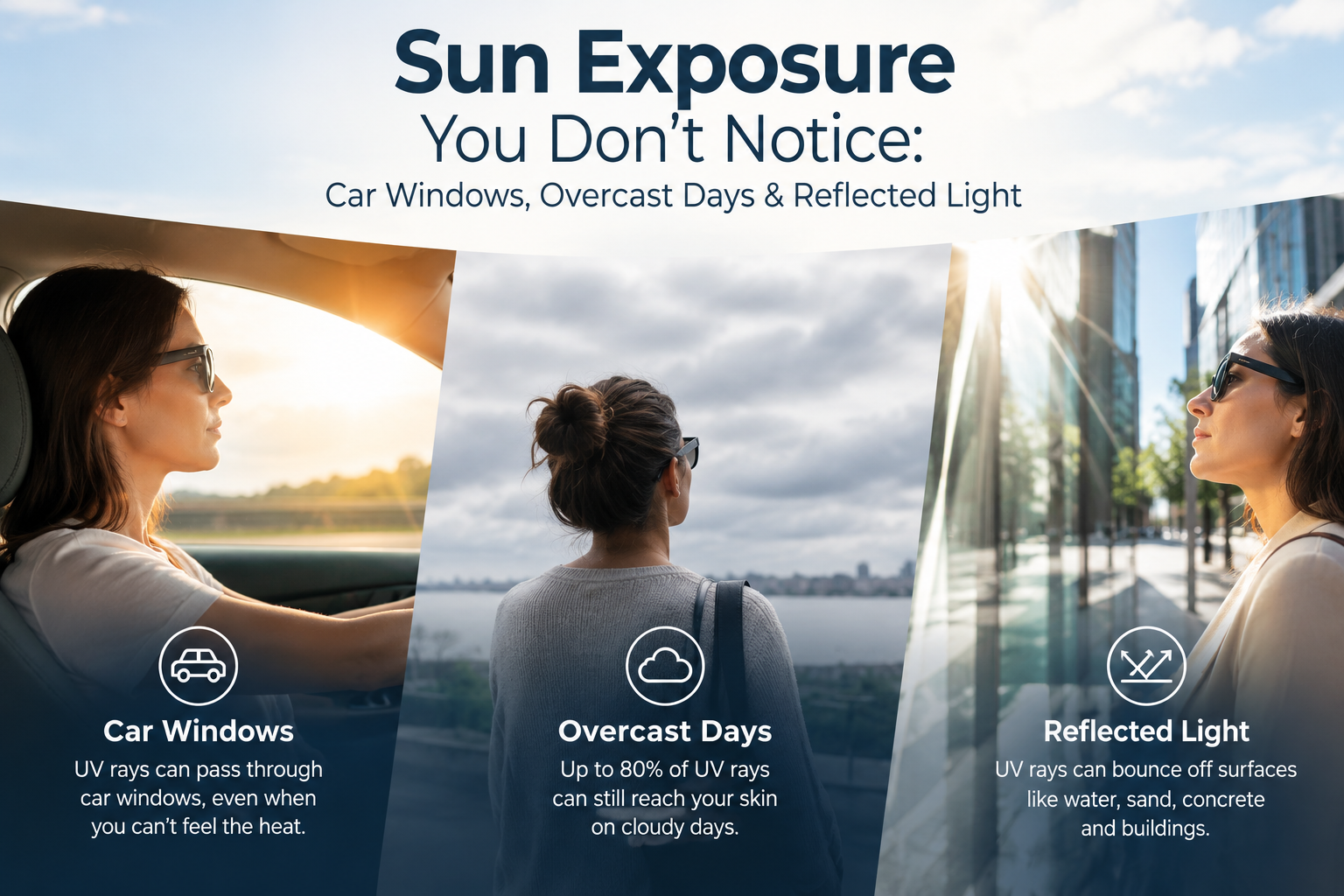
It is easy to think of sun protection in terms of the obvious moments. A beach day calls for sunscreen and a hot afternoon calls for a hat, yet a cool or cloudy day can still carry enough UV to damage your skin. A drive to work with the window down, a walk to the car under grey skies or a weekend by the water can all add to your UV exposure, even when you never feel a hint of sunburn. Over the years, these everyday moments add up.
Key Takeaways
- UV exposure can occur on cloudy days, as thin or scattered cloud may still allow UV levels high enough to damage skin.
- Reflected UV adds to exposure, with sand, water, concrete, glass and other surfaces reflecting radiation back towards the skin.
- Car windows do not block all UVA, particularly side and rear windows, leaving the face, neck and arms exposed during regular driving.
- Everyday UV exposure accumulates over time, with damage occurring even without obvious sunburn and contributing to long-term skin damage.
- Daily protection should follow UV levels, including sunscreen, shade and professional skin checks to identify damage that may not be visible.
Why Grey Skies Can Still Burn Your Skin
Cloud cover can make a day feel cooler, but it does not always keep UV away. Cancer Council NSW notes that UV levels can reach 3 or above on cool or cloudy days, which is high enough to damage your skin. Thick cloud is a good filter for UV radiation, while thin or scattered cloud does little to reduce it.
Because clouds take the edge off the heat and glare, the usual cues to cover up are missing. Pink or tight skin after an overcast afternoon outdoors can still be sunburn, whatever the sky looked like at the time. The daily UV level is a far more reliable guide than the weather, and Cancer Council NSW recommends checking it every day.
UV Can Hit You From Below
Direct sunlight is only part of the picture. Some surfaces reflect UV back towards your skin. Dry beach sand reflects 15% to 18% of UV radiation, white sea foam reflects 25% to 30%, and snow reflects between 50% and 88%.
An umbrella or a wide-brimmed hat shades you from above, but neither protects you from UV reflected up off the sand and water. Away from the beach, ARPANSA notes that hard surfaces, such as steel, glass and concrete, reflect more UV than soft surfaces, such as soil or grass, and that lighter colours reflect more than darker ones. A paved courtyard, a concrete footpath or a glass-fronted building can all add to the UV you receive on an ordinary day.
What Your Car Windows Do and Don’t Block
A car can feel as sheltered as a room at home, so sun protection is easy to forget once you are behind the wheel. Windscreens are made from laminated glass, which has a tough plastic layer bonded between two panes. Figures from the Cancer Council reported by Drive.com.au put its protection at around 98% of UVA radiation.
Side windows, rear windows and sunroofs are a different matter. They are usually made from tempered glass, which lets more UVA through, and the level of protection varies widely depending on how thick the glass is. On a daily commute or a long day of driving between jobs, the arm, neck and side of your face nearest the window are exposed through that glass, and the exposure adds up over months and years even if you never feel burnt.
How Everyday Exposure Builds Into Lasting Damage
None of these situations usually leaves an obvious burn, which is exactly why they are easy to overlook. Cancer Council NSW explains that UV damage is not always visible. It begins long before a sunburn or tan appears and is both permanent and cumulative. Years of drives to work, dog walks on cloudy mornings and afternoons by the pool can add up to significant damage, even if you have never set out to sunbake.
Simple Habits for Year-Round Sun Protection
You do not need to worry about every trip to the car or every grey Tuesday. The aim is to let the UV level guide your sun protection, rather than the temperature or the cloud cover.
A few small adjustments can lower your lifetime UV exposure without much extra effort:
- Check the daily UV level and use sun protection whenever it reaches 3 or above, whatever the weather looks like.
- Apply sunscreen to your face, neck and arms before regular drives and longer trips.
- Pair shade with sunscreen near water, since an umbrella will not stop UV reflecting off sand and surf.
Get Your Skin Checked for Hidden Sun Damage
Because so much of this exposure goes unnoticed, a look in the mirror is unlikely to show how much damage your skin has built up. A skin assessment gives you a clearer picture. A trained professional, such as a melanoma specialist, can pick up early changes that are easy to miss on your own, particularly in spots that often go unchecked, such as the arm closest to the car window, your ears and skin that catches reflected light near water or paving.
If your skin has not been properly assessed for a while, book a visit to a skin cancer clinic. A professional skin check is a simple way to find out where your skin stands, rather than relying on how often you have or have not been sunburnt.
Common Questions About Hidden UV Exposure
Can I get sunburnt on a cloudy day?
Yes. UV levels can reach 3 or above on cool or cloudy days, which is enough to damage your skin. Thick cloud filters UV well, but thin or scattered cloud does little to reduce it.
Do car windows block all UV radiation?
No. Laminated windscreens block around 98% of UVA, but side windows, rear windows and sunroofs are usually made from tempered glass, which lets more UVA through. Your arms and face can still be exposed during regular driving.
Why does the beach feel more damaging than other outdoor settings?
Reflected UV plays a big part. Dry beach sand reflects 15% to 18% of UV radiation and white sea foam reflects 25% to 30%, so you receive UV from the sky and from the surfaces around you.
Is snow really more reflective than sand or water?
Yes, sunburn remains a risk in snowy conditions, even when the air feels cold. Snow reflects 50% to 88% of UV radiation, which is higher than 15% to 18% reflected by dry beach sand and 25% to 30% reflected by sea foam.
How do I know if years of low-level sun exposure have caused damage?
A professional skin check is the most reliable way to find out. UV damage is not always visible and can begin long before a sunburn or tan appears, so regular checks are worthwhile even if you have never had a severe sunburn.
