
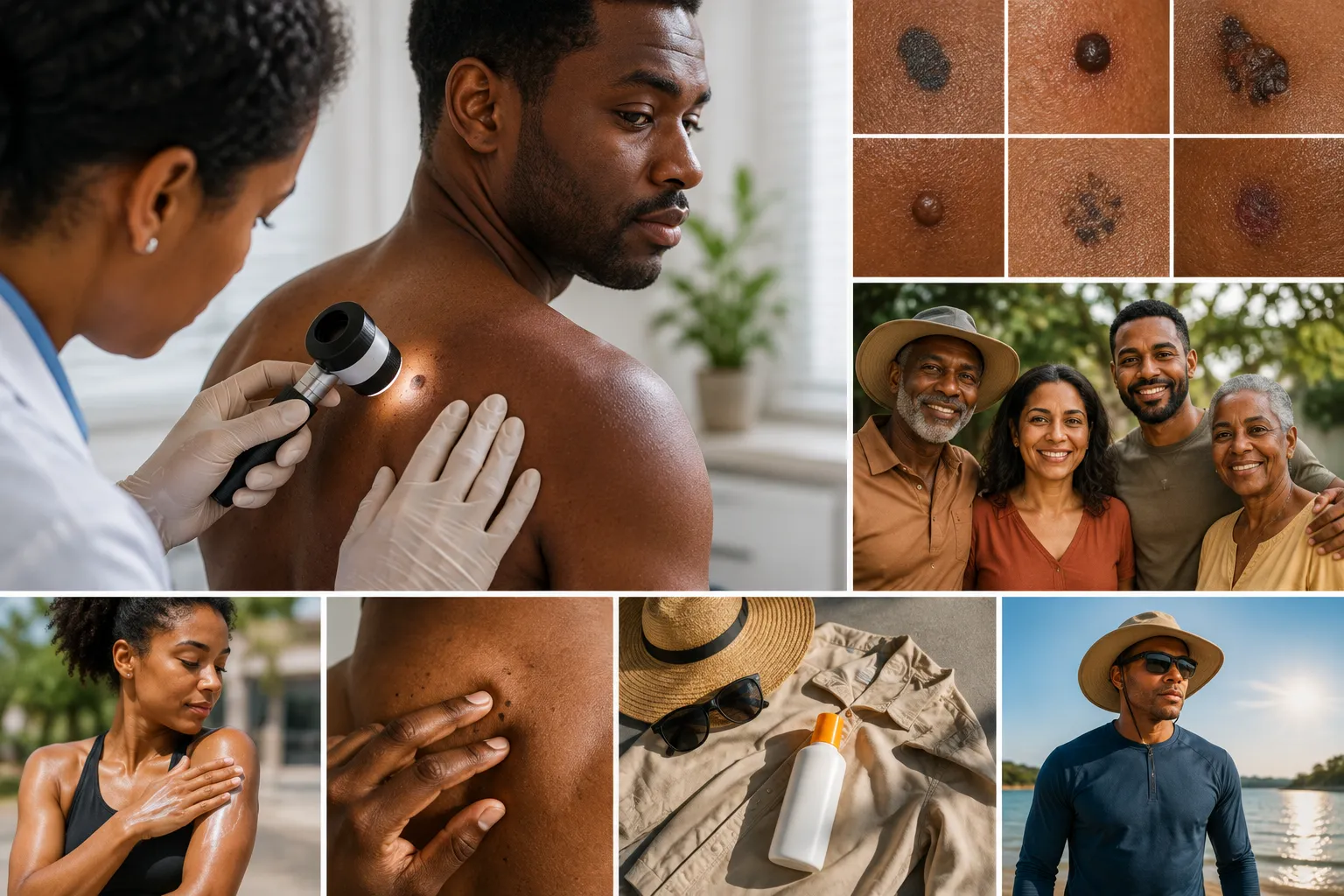
Skin cancer awareness in Australia has been built around one image: fair skin, a red shoulder, a long day at the beach. That messaging has saved lives, but it has also drawn a boundary around who thinks the warning applies to them.
People with darker skin tones develop skin cancer too, and when they do, it tends to be found later and treated at a more advanced stage. If you have ever assumed your skin tone excuses you from skin checks, the picture is more complicated than that.
Less Common, But Never Impossible
Melanin, the pigment that gives skin its colour, does offer some natural protection against UV radiation. People with darker skin tones carry a lower overall risk of developing skin cancer than fair-skinned people do.
But lower risk is not the same as no risk, and the difference between those two ideas is where the problem starts.
Australian figures show the size of the gap. An analysis of melanoma rates found an incidence of 30.4 cases per 100,000 people among non-Indigenous Australians, compared with 14.1 cases per 100,000 among Aboriginal and Torres Strait Islander Australians, according to research reported by Dermatology Times. Half the rate is still a meaningful rate. Survival outcomes for those who are diagnosed are not automatically better, which is where the real concern lies.
Why the Warning Signs Get Missed for Longer
Delay is the real issue. Skin cancer is picked up later in darker skin than in fair skin, and that late detection, rather than anything about the disease itself, explains most of the difference in survival rates. Nobody is expecting it, which shapes what gets ruled out first.
A pigmented patch on the sole of a foot looks like a fungal problem to most eyes and will often be treated as one for months at a time. Nail changes get blamed on a knock the patient does not remember. Those explanations are usually correct, which is what makes them so hard to argue with, and a lesion can keep growing while everybody waits for the treatment to start working.
The training doctors receive has not helped much either. Fewer than 5% of clinical textbook images reviewed in one analysis featured dark skin tones, according to reporting from Oncology Republic. If almost everything you were shown during your training was fair skin, you are left to work out the translation on your own, in the moment, with a real patient in front of you.
Patients have the same problem in reverse. Years of sun safety advertising built around pale, sunburnt skin gave a lot of Australians good reason to assume the warning was aimed at somebody else.
The Spots Most People Never Think to Check
A lot of the skin cancer found in darker skin turns up in places that get almost no sun, so the usual advice about faces and shoulders is incomplete rather than wrong. Those areas still need checking, along with several that most people never think to look at.
Any spot or patch that grows or changes shape is worth showing to someone, and the same goes for a sore that will not heal or a lump that was not there before. Dark lines appearing under a nail count as well, as does any patch of skin that looks unlike the skin surrounding it. These places deserve particular attention:
- Palms of the hands and soles of the feet
- Under or around the nails, often as a dark vertical streak
- Inside the mouth or on the genitals
- Old scars, burns, or wounds that never fully healed
- Skin affected by long-term inflammation
None of these signs confirms skin cancer on their own. They do justify a visit to a skin cancer clinic, and a mark that changes slowly over weeks or months is worth showing to someone regardless of where it sits on your body.
Schedule Your Skin Check Before You Notice a Problem
Skin cancer does not check your complexion before it develops, and finding it should not take longer simply because nobody expected it. One short appointment with a melanoma specialist is one of the simplest protections available to you, whatever your skin looks like.
Questions About Skin Cancer and Darker Skin
Does having darker skin mean I do not need sunscreen?
No. Melanin provides some UV protection, roughly equivalent to a low SPF, which falls well short of what an Australian summer demands. Sunscreen also helps prevent photoageing and pigmentation changes that many people with darker skin want to avoid anyway.
Can people with dark skin get skin cancer?
Yes, it does happen. Melanin gives you some protection from UV damage, but protection is not immunity, and people with brown and black skin are diagnosed every year. The bigger worry is timing because these cancers are usually found once they have had time to develop, and that puts patients on the back foot from the start.
Why is skin cancer often diagnosed later in people with darker skin?
Nobody involved is looking for it. Patients tend to assume skin cancer belongs to fair-skinned people, and doctors were trained on textbooks that showed them very little of what it looks like on brown or black skin. Awareness campaigns have leaned the same way for years, so the assumption keeps getting reinforced instead of challenged.
Where does skin cancer usually appear on darker skin?
Often in areas that see little or no sun, including the palms, soles, nail beds, inside the mouth, and old scar tissue. Acral lentiginous melanoma, which appears on palms, soles and under nails, accounts for a far larger share of melanoma diagnoses in people with darker skin than it does in fair-skinned patients.
How often should I get a skin check if I have darker skin?
Once a year is a sensible baseline. Your doctor may want to see you more often if skin cancer runs in your family, if you have already had a lesion removed, or if you have a lot of moles to keep track of. Between appointments, it helps to know your own skin well enough to notice when something changes.
