
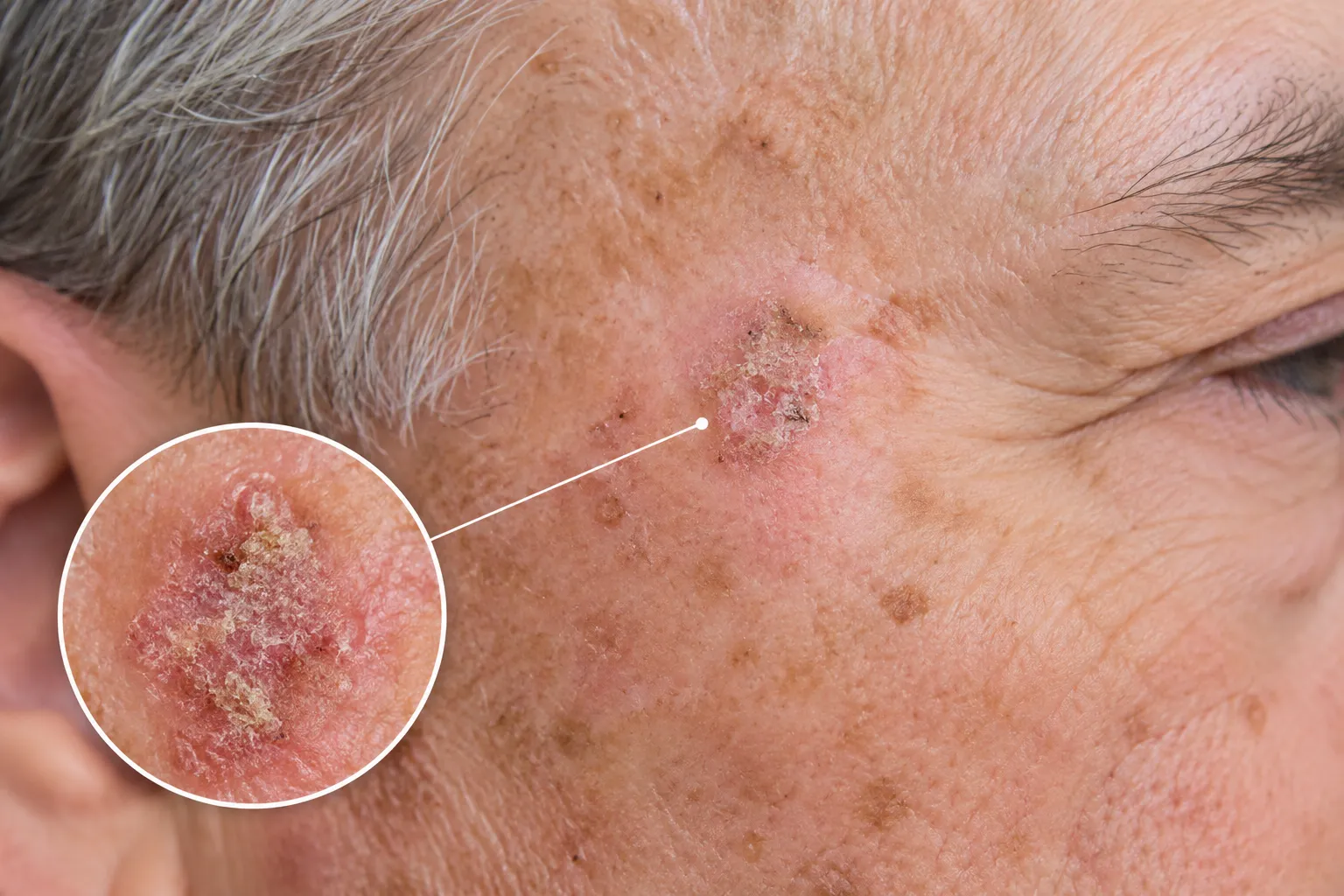
Actinic keratosis often starts as nothing more than a rough, dry patch that feels a bit like sandpaper under your fingertip. It is one of the most common skin concerns Australian doctors see, yet it looks nothing like the image of skin cancer most people have in mind.
Patches like this are easy to put down to dry skin, sun damage or age and then leave alone for years. Once you know what actinic keratosis is, and what it says about your skin’s sun history, you can tell when a rough spot deserves a second look.
Key Takeaways
- Actinic keratosis is a common result of cumulative sun damage, appearing as rough, scaly or crusty patches on chronically sun-exposed skin.
- These spots are considered precancerous, meaning some can develop into squamous cell carcinoma if left untreated.
- Early recognition is important, particularly when lesions change, become thicker, bleed, crust or fail to heal.
- Treatment options vary depending on the lesions, with approaches including topical treatments, cryotherapy, curettage and photodynamic therapy.
- Ongoing sun protection and skin checks are essential, helping reduce further damage and identify suspicious changes or developing skin cancers early.
What Actinic Keratosis Looks Like and Where It Appears
Actinic keratosis, also called solar keratosis, forms when skin cells are damaged by sun exposure that has built up over many years. One bad sunburn is rarely the cause. The damage adds up slowly over decades, so actinic keratosis turns up more often in older adults, particularly those who have spent long stretches of their lives outdoors, usually on the face, ears, scalp, forearms and backs of the hands.
The spots tend to be small, with a texture that feels rough under your fingers. The colour can be pink, red, brown or close to your natural skin tone, and some spots come and go, itch or become tender now and then.
Actinic keratosis is classed as a precancerous condition. The cells are damaged but have not become cancerous, although a cancer can develop from that damage if the spot is left untreated.
How Common Actinic Keratosis Is in Australia
Research published by the Royal Australian College of General Practitioners puts the prevalence of actinic keratosis among Caucasian Australians over 40 at 40% to 50%. The rate climbs steeply with age, from less than 10% of people in their 20s to more than 80% of people in their 60s and 70s. An Australian population survey cited in the same paper found that people with actinic keratosis have six to eight lesions on average. For adults who have spent years in the Australian sun, actinic keratosis is a common finding.
The Link Between Actinic Keratosis and Squamous Cell Carcinoma
Most individual actinic keratosis spots do not progress to skin cancer. The same research estimates the chance of a single lesion becoming squamous cell carcinoma at around 1% over 10 years.
The count of spots matters more. People with more than five actinic keratosis lesions have a higher relative risk of developing squamous cell carcinoma somewhere on their skin, with more damaged skin in play for a lesion to progress.
Actinic keratosis is best read as a record of your skin’s sun damage. Several patches give you and your doctor a clearer picture of where your skin sits on the risk scale, now and in the years ahead, and that picture is worth acting on rather than filing away.
How a Doctor Diagnoses and Treats Actinic Keratosis
A check for a suspected actinic keratosis is a short appointment, and when found at an early stage, it can generally be treated with simpler, less invasive methods. A doctor, dermatologist or melanoma specialist can examine the area, sometimes through a handheld magnifying device called a dermatoscope, and in many cases can confirm actinic keratosis from its appearance alone. If it is unclear whether a spot is actinic keratosis or something more serious, your doctor can remove a small sample and send it off for testing.
Treatment depends on how many spots you have and where they sit on your body. Individual lesions are often frozen off, and light-based treatment is used for more widespread damage. Both are performed in the clinic. Prescription creams, applied at home over a set course, suit people with multiple lesions across one area.
Have Rough or Scaly Patches Checked Early
Actinic keratosis, sun spots, early skin cancer and ordinary dry skin can look very similar in the bathroom mirror. A skin check gets you an answer sooner than waiting to see whether a spot changes, and a trained eye picks up differences that are hard to see on your own.
If your skin has not been properly examined for a while, or a rough patch has not gone away, a visit to a skin cancer clinic is a sensible next step. The appointment is quick, and you leave with a clear answer about that dry patch on your forehead.
Frequently Asked Questions
Is actinic keratosis the same as skin cancer?
No, actinic keratosis is not skin cancer. It is a precancerous condition where sun damage has affected the skin cells, but they have not turned cancerous. Left untreated, it signals a higher chance of skin cancer developing over time, most often squamous cell carcinoma.
Can actinic keratosis go away on its own?
Actinic keratosis can go away on its own sometimes, although usually not for good. A spot may fade for a while, particularly once you cut back on sun exposure, but it often comes back. Actinic keratosis points to ongoing sun damage, so only a proper assessment can tell you whether it needs treatment.
Does having actinic keratosis mean I’ll get skin cancer?
It does not have to. Each individual spot carries a low chance of progressing, estimated at around 1% over 10 years. Your overall risk of squamous cell carcinoma rises once you have more than 5 lesions, and regular monitoring helps your doctor pick up any change early.
How is actinic keratosis usually treated?
Treatment usually involves freezing individual spots or applying a prescription cream across a larger patch of skin. Light-based therapy is another option where the damage is more widespread. Your doctor will choose between them based on how many spots you have and where they sit on your body.
Who is most at risk of developing actinic keratosis?
Adults over 40 with fair skin and a lot of sun exposure across their lifetime carry the highest risk. That group includes outdoor workers and anyone who spent long hours in the sun without regular protection earlier in life.
