
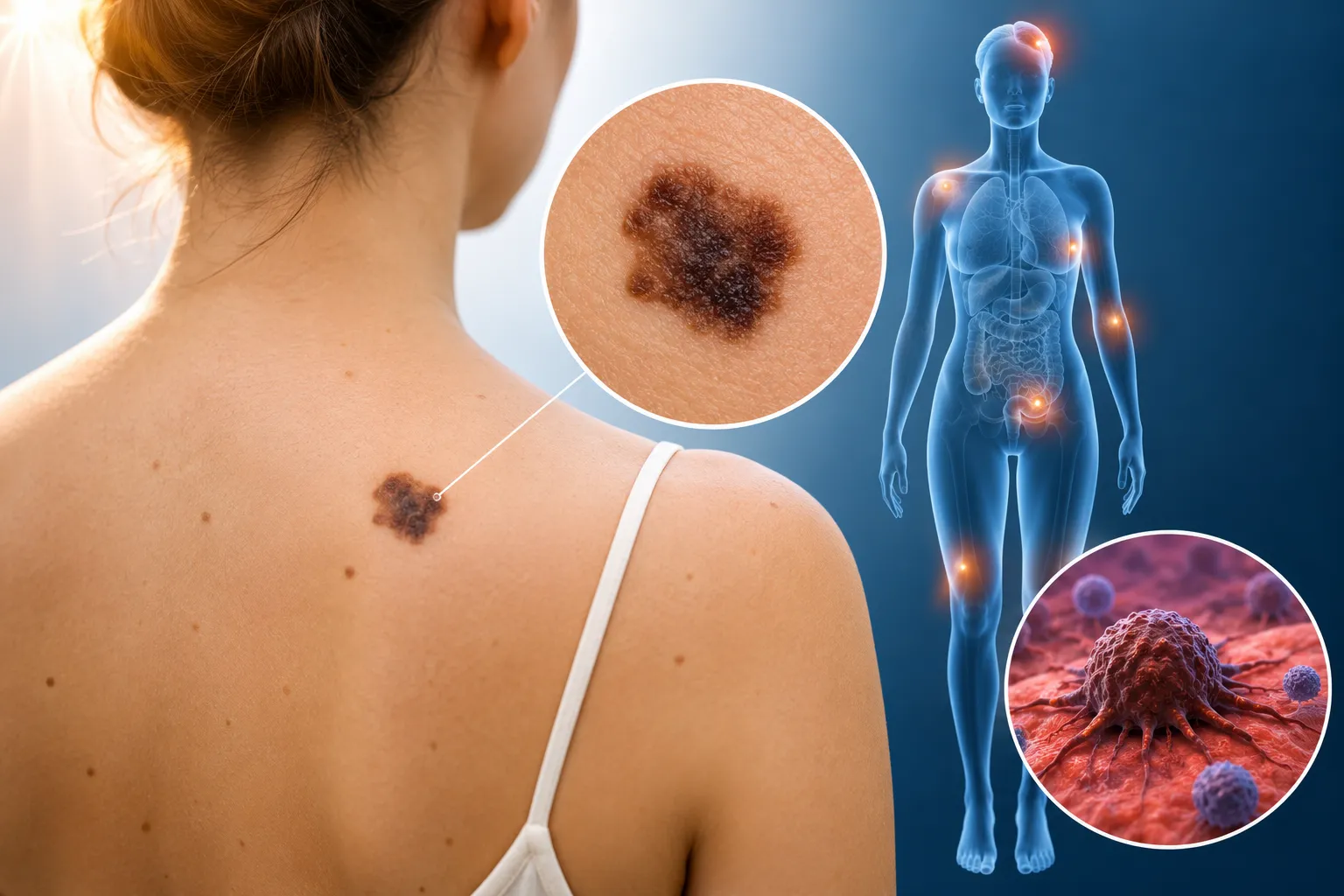
Melanoma is not the most common skin cancer, but it carries the greatest risk. Other skin cancers tend to remain contained and respond well to treatment, but melanoma behaves differently from the start.
When found at an advanced stage, it spreads rapidly, reaches organs beyond the skin, and responds less effectively to treatment. Here is what sets it apart from the rest.
Key Takeaways
- Melanoma is the most dangerous skin cancer: Unlike other common skin cancers, melanoma develops in pigment-producing cells and can spread rapidly to the lymph nodes, lungs, liver, and brain if left untreated.
- Australia has exceptionally high melanoma rates: Intense UV exposure, a large fair-skinned population, and outdoor lifestyles contribute to Australia and New Zealand having some of the highest melanoma incidence rates globally.
- Early detection greatly improves outcomes: Stage 1 melanoma has a five-year survival rate above 98%, while later-stage melanoma is more difficult to treat despite advances in modern therapies.
- Know the warning signs: The ABCDE rule—Asymmetry, Border irregularity, Colour variation, Diameter over 6mm, and Evolution—helps identify suspicious spots that require medical assessment.
- Certain people face higher risk: Fair skin, numerous or atypical moles, family history, previous melanoma, significant sun exposure, childhood sunburns, and tanning bed use all increase melanoma risk, making regular skin checks essential.
What Makes Melanoma Different from Other Skin Cancers
Most skin cancers develop in the top layer of the skin and tend to stay there, which makes them easier to treat. Melanoma takes a different path. It begins in the melanocytes, the pigment-producing cells that determine skin colour.
Because these cells travel throughout the body during development, melanoma has pathways that other skin cancers lack. Without early detection and treatment, it can reach the lymph nodes, lungs, liver, and brain. This sets it apart from the two most common skin cancers in Australia.
Basal cell carcinoma and squamous cell carcinoma are serious but rarely life-threatening when treated early. In contrast, melanoma accounts for the vast majority of skin cancer deaths. It can spread quickly, and its tendency to appear on any part of the body, not just sun-exposed areas, sets it apart from the rest.
The Reason Melanoma Hits Australia Harder Than Almost Anywhere Else
According to the Australian Skin Cancer Foundation, Australia and New Zealand record the world’s highest incidence of melanoma, with the disease ranking as the third most commonly diagnosed cancer in the country.
Geography is among the top factors driving these high rates. Australia’s proximity to the equator means the population is exposed to high levels of ultraviolet radiation, particularly in summer. A thinner ozone layer over parts of the country increases exposure, allowing more UV radiation to reach the ground than in most other regions.
Beyond geography, fair-skinned populations are particularly vulnerable to UV damage, and Australia has a large proportion of people whose skin was not evolutionarily adapted to the intensity of the Australian sun. Add decades of outdoor work, beach culture, and low sun protection habits, and the conditions are ripe for these numbers to climb.
What Stage of Melanoma at Diagnosis Actually Means
When a doctor refers to the stage of melanoma, they are describing how far the cancer has progressed. A melanoma caught at stage one is a very different situation from one that has been growing unnoticed for years.
Stage one means the melanoma is thin and confined to the skin with no sign of spread. Stage four means it has reached distant organs.
At stage one, the five-year survival rate sits above 98%. The rate drops significantly when detection is later, though newer treatments have considerably improved outcomes. The stage at diagnosis is one of the strongest predictors of treatment outcomes.
Better Treatments and Earlier Detection Are Changing the Outlook
Treatment for advanced melanoma looks very different today.
- Immunotherapy, which helps the immune system recognise and attack cancer cells, has transformed outcomes for patients with advanced melanoma.
- Therapies that target specific genetic mutations have also extended survival for many.
- Dermoscopy and total body photography have improved the accuracy of skin examinations.
- Artificial intelligence tools now assist clinicians in detecting suspicious lesions with greater precision.
Together, these advances mean that a diagnosis of advanced melanoma is no longer the immediate death sentence it once was. Early detection remains the most reliable path to a good outcome.
What Melanoma Actually Looks Like on Your Skin
Melanoma does not always look like a dramatic mark. Many start as small spots that look similar to a regular mole. The ABCDE system is the standard framework for knowing what to watch for.
- Asymmetry: One half of the spot does not match the other.
- Border irregularity: Edges are ragged, notched, or blurred.
- Colour: A single lesion contains more than one shade, such as brown, black, or red.
- Diameter: Anything larger than 6 millimetres needs flagging, although melanomas can sometimes be smaller.
- Evolution: Any change in size, shape, or colour, or a new symptom such as bleeding or itching, should be assessed by a specialist promptly.
Some melanomas are not pigmented at all and appear as pink or flesh-coloured lesions, which makes them harder to spot. That is why it’s better to consult a melanoma specialist if there is any new or changing spot, regardless of how minor it looks.
Who Is More Likely to Develop Melanoma
Your personal and family history is the starting point. A prior melanoma diagnosis or a close relative who has had one raises your risk profile considerably and usually means more frequent skin checks are worth scheduling.
The number and appearance of your moles matter too. Having many moles, particularly those that look atypical or irregular, adds to that picture, as does fair skin, light-coloured eyes, and skin that burns rather than tans.
How you have lived in the sun compounds these baseline factors. Prolonged exposure over a lifetime increases risk steadily, but blistering sunburns during childhood or adolescence carry particular weight because the damage accumulates early. Tanning bed use, often underestimated, is a confirmed risk factor that adds to that cumulative load.
Older adults and men face a statistically higher risk overall, though it is worth noting that melanoma is one of the more commonly diagnosed cancers in young Australians relative to other cancer types.
Get Your Skin Checked Before Melanoma Gets a Head Start
Waiting until something looks obviously wrong is one of the most common reasons melanoma is diagnosed at a later stage. A professional skin check gives a specialist the chance to spot changes and suspicious lesions that would not register to the untrained eye, often long before they become a serious problem.
Whether you have a spot that has recently changed or simply have not had a check at a skin cancer clinic in a while, now is the right time to act. Early detection is what keeps treatment straightforward. Book your skin check today.
