
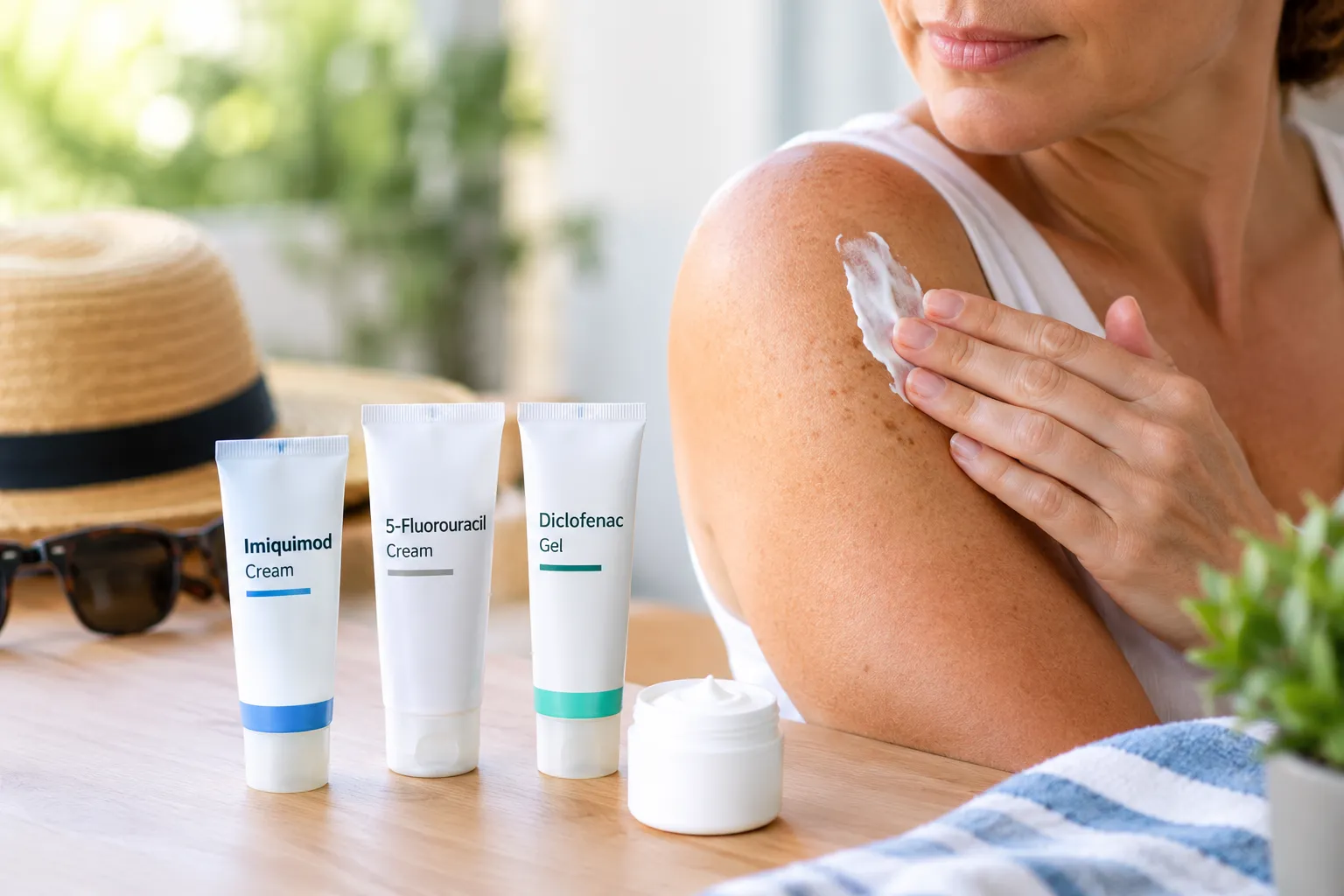
A diagnosis of a sunspot or early skin cancer often comes with one big question: does this mean surgery? For some spots, the answer is no because a topical cream for skin cancer can treat the problem without a single cut. Creams only suit certain types of skin cancer, though, and using one on the wrong spot can allow a cancer to keep growing. This guide explains in plain English which spots creams suit and which they do not, along with why an accurate diagnosis always comes before any treatment.
Key Takeaways
- Topical creams can treat selected skin cancers, particularly superficial basal cell carcinomas and certain precancerous lesions, without requiring traditional surgery.
- Common medications include 5-fluorouracil and imiquimod, which work by damaging abnormal cells or stimulating the immune system to target them.
- Treatment suitability depends on the diagnosis, including the cancer type, depth, location and stage, as well as the patient’s overall health.
- Side effects can occur during treatment, and patients may need to manage local skin reactions while following their clinician’s instructions.
- Medical supervision and follow-up are essential, as topical creams are not suitable for every skin cancer, and ongoing skin checks help detect recurrence or new lesions.
Australia’s Skin Cancer Rates and What They Mean for You
Australia has some of the highest skin cancer rates in the world. Cancer Council Australia estimates that two in three Australians will be diagnosed with skin cancer by the age of 70. With odds like these, most people will have to weigh up treatment choices at some stage, so it pays to understand what each option can and cannot do before you need it.
How Skin Cancer Creams Target Abnormal Cells
A topical treatment for skin cancer is a medicine you apply straight onto the skin, usually at home, over a course of several weeks. The two creams doctors prescribe most often take different approaches.
- Fluorouracil cream targets fast-growing abnormal cells and destroys them, while largely sparing the healthy skin around them.
- Imiquimod cream works through your immune system instead, prompting it to seek out and attack the abnormal cells.
Both creams are available on prescription only and must be used under a doctor’s supervision. Some doctors also turn to other creams or gels when the sun damage is milder.
Skin Spots That May Respond Well to a Cream
Topical medicine for skin cancer gives the best results on problems confined to the uppermost layers of the skin. Three types of spots fall into this group.
1. Sunspots (actinic keratoses)
These rough, scaly patches are not cancer yet, although some can develop into squamous cell carcinoma over time. A cream is especially useful when spots are spread across a large area such as the face, scalp or forearms. It treats the whole area in one go, including spots that are still too small to see.
2. Superficial basal cell carcinoma
Basal cell carcinoma is the most common skin cancer in Australia, and the superficial type is a thin, flat form of it. A cream may be an option when the spot is small and sits in a suitable place.
3. Squamous cell carcinoma in situ
Also known as Bowen’s disease, this is an early squamous cell carcinoma that has stayed within the top layer of skin. A cream is one of the ways a doctor may treat it.
Creams can also be a good fit for people who prefer to avoid surgery, are not well enough to have it, or have spots where scarring would be a concern. Your doctor can talk you through whether any of these situations apply to you.
When Surgery Is the Safer Choice
A topical skin cancer ointment is generally not suitable for:
- Melanoma. It has to be surgically removed by a melanoma specialist, and creams are not a standard treatment for it.
- Thicker or deeper basal cell carcinomas. Nodular and more aggressive types grow down into the skin, beyond the reach of a cream.
- Invasive squamous cell carcinoma. Surgery is usually needed once it has grown into deeper layers.
- Spots that return after earlier treatment.
- Spots in tricky areas such as near the eyes, lips or nose, where a doctor may favour surgery for a more reliable result.
The greatest danger lies in treating a spot that has not been properly diagnosed. A cream may clear the surface of a deeper cancer while the cancer keeps growing below it. That’s why your doctor will usually take a small tissue sample, known as a biopsy, to confirm exactly what the spot is before recommending any topical medication for skin cancer.
Side Effects, Healing Time and Aftercare Tips
Topical creams for skin cancer are simple to apply, but the treatment is not always comfortable. The treated area will often look worse before it starts to improve, with redness, swelling, crusting, weeping and itching all common. These reactions are usually a sign that the cream is doing its job.
Most courses last a few weeks, and the skin generally heals over a similar period once you finish. A handful of habits will help your treatment go smoothly:
- Stick exactly to the schedule your doctor gives you.
- Keep the treated area out of the sun.
- Wash your hands after every application.
- Check with your doctor before you stop early.
- Book a follow-up appointment so the area can be reviewed.
For basal cell carcinoma, creams also tend to have a slightly lower success rate than surgery, which is why follow-up skin cancer checks are so important. Regular reviews let your doctor confirm the spot has cleared or pick up any sign that it needs a different approach.
Book a Skin Check Before You Choose a Topical Cream for Skin Cancer
The right cream on the right spot can be an excellent treatment, but first you need to know which spot is which. A skin check with an experienced doctor, together with a biopsy where needed, will show whether a cream, surgery or another treatment suits you best.
Please keep in mind that this article is general information and not medical advice. If you have noticed a new or changing spot, book a skin check and talk through your options.
Your Questions About Skin Cancer Creams Answered
Can a cream cure skin cancer?
In some cases, yes. Early skin cancers that stay on the surface, such as superficial basal cell carcinoma and squamous cell carcinoma in situ, can be cleared with a topical cream. Melanoma and deeper skin cancers usually need surgery instead.
How long does it take for skin cancer cream to work?
A typical course runs for 2 to 6 weeks, depending on the cream and the type of spot. The skin usually heals within a few weeks of finishing treatment, and your doctor will check the area afterwards to make sure it has cleared.
Does skin cancer cream hurt?
It can cause some discomfort. Stinging, redness, itching, crusting and weeping often appear during treatment, and these usually mean the cream is working. Contact your doctor if the reaction turns severe or you begin to feel unwell.
Can I buy skin cancer cream over the counter?
No. In Australia, creams for sunspots and skin cancers are available on prescription only. A doctor needs to diagnose the spot, prescribe the right cream and keep an eye on how you are progressing.
Is a cream better than surgery?
Not always. Surgery generally has a higher success rate, and it allows the removed tissue to be examined under a microscope. Creams avoid cuts and stitches and suit certain spots that sit on the surface of the skin. Your doctor will recommend the option that best fits your situation.
