
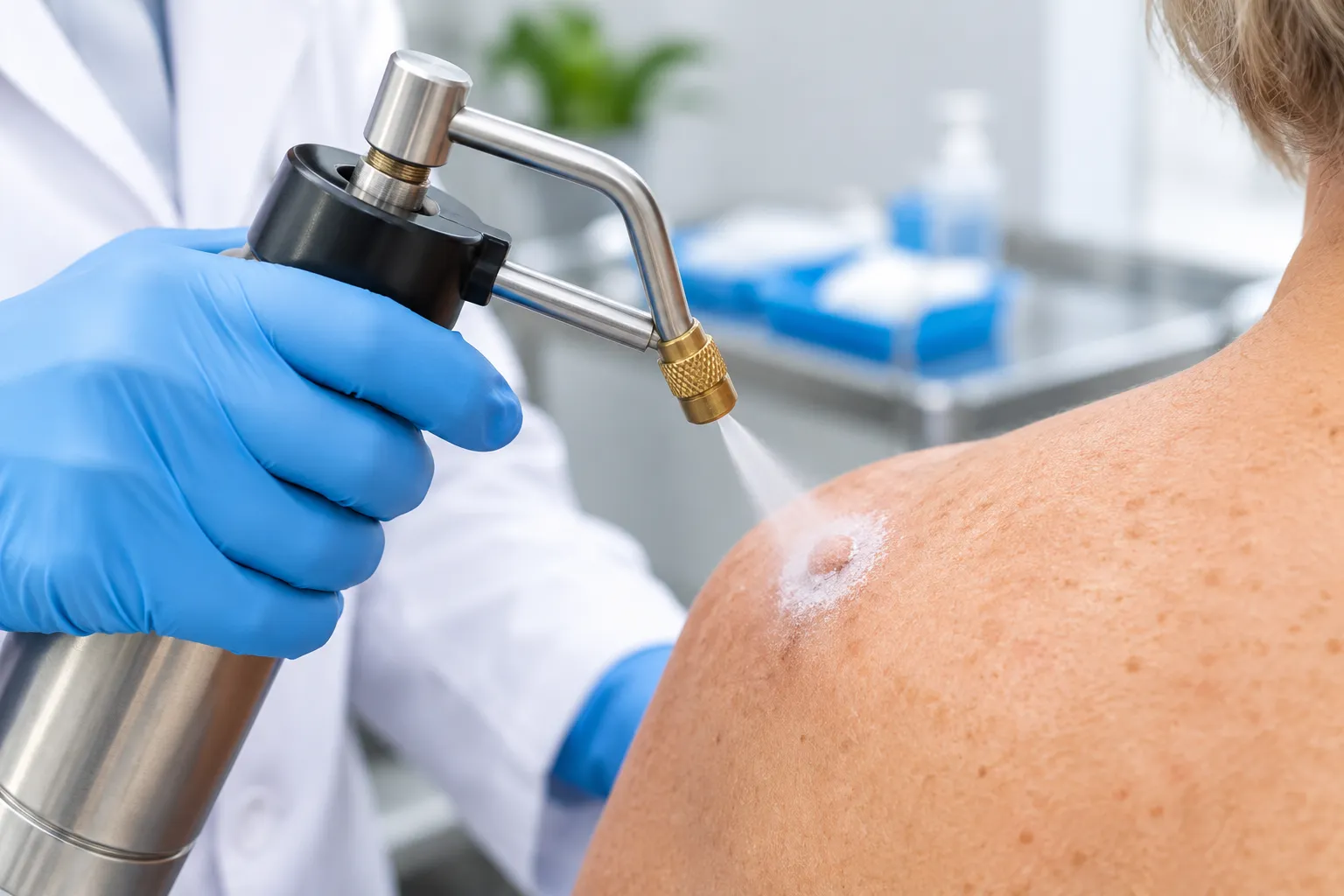
If your doctor has recommended freezing a spot with liquid nitrogen, the idea might sound far more dramatic than the reality. Cryotherapy is a common treatment in Australian skin clinics, and the procedure itself is quick, well-established, and much simpler than its name suggests.
Key Takeaways
- Cryotherapy uses liquid nitrogen to freeze abnormal skin cells, causing the treated tissue to blister, die and eventually fall away.
- It can be used for selected skin cancers, particularly small or superficial lesions where cryotherapy is considered medically appropriate.
- Treatment can cause temporary discomfort, with stinging during application followed by blistering as the treated area heals.
- Cryotherapy is not suitable for every skin cancer, as treatment choice depends on the cancer type, size, depth and location.
- A professional assessment is essential before treatment, ensuring the lesion is correctly diagnosed and the most appropriate treatment approach is selected.
How Cryotherapy Works on Abnormal Skin Cells
Cryotherapy relies on extreme cold, usually in the form of liquid nitrogen, to destroy damaged or abnormal skin cells. Your doctor applies the liquid nitrogen straight onto the spot with a spray device or a cotton-tipped applicator.
The freeze reaches a temperature low enough to damage the abnormal cells, while the healthy skin around them is left largely unaffected. The frozen cells then die off over the days and weeks that follow, and your body sheds them as part of its normal healing process.
Unlike surgery, cryotherapy does not involve cutting out a section of tissue. The cold prompts your skin to clear away cells that should not be there.
Which Skin Spots Cryotherapy Can Treat
Cryotherapy is not suitable for every type of skin cancer, so it helps to know where it fits before your appointment.
According to Australian Prescriber, liquid nitrogen cryotherapy is the primary treatment for solar keratoses (commonly called sunspots) in Australia. A short freeze of two to five seconds removes about 70% of solar keratoses treated this way.
Doctors also use it on some low-risk basal cell carcinomas and on Bowen’s disease, also known as squamous cell carcinoma in situ. These are generally treated this way when they appear on the trunk and limbs. Facial skin is the main exception. Cryotherapy has lower cure rates on the face, so other treatments are used instead.
Cryotherapy is not used to treat melanoma. The same Australian Prescriber article notes that melanoma is usually removed surgically, and that non-surgical treatments should not be used when the diagnosis is unclear. For this reason, a spot that raises any concern about melanoma should be assessed by a melanoma specialist before a treatment is chosen, rather than frozen on the assumption that it is a harmless sunspot.
Inside a Typical Cryotherapy Appointment
A cryotherapy appointment is usually brief. Your doctor first examines the spot, sometimes with a dermatoscope for a closer and clearer view, then applies the liquid nitrogen directly to the area.
You can expect a sharp, cold sensation, followed by mild stinging or burning that settles fairly quickly. In most cases, there is no cutting, no stitches and no need for local anaesthetic, which is part of the reason cryotherapy is often used for smaller, well-defined spots.
How Your Skin Recovers After Freezing
Over the next few days, the treated area will usually turn red, swell a little and sometimes blister. These changes can look worrying if you are not prepared for them, but they are a normal part of healing and not a sign that the treatment has gone wrong. Over the following one to six weeks, depending on the size and location of the spot, the damaged tissue dries out, forms a scab and eventually falls away to reveal new skin underneath.
Aftercare is simple, and most of it comes down to protecting the area while it heals. Focus on these three things:
- Keep the treated spot clean.
- Leave any scab alone rather than picking at it.
- Protect the area from further sun exposure.
In most cases, you can return to your usual routine straight after treatment. There is no need to take time off work or plan around a lengthy recovery, which makes cryotherapy a convenient option for a busy schedule.
Keeping an Eye on Treated Spots
Cryotherapy is not a ‘set and forget’ treatment. It deals with the spot in front of your doctor on the day, but it cannot reverse years of sun exposure or stop new spots from appearing elsewhere. That is why follow-up deserves as much attention as the treatment itself. If a treated area does not fully clear, looks different from how your doctor described it, or a new spot shows up nearby, have it checked properly instead of waiting for it to resolve on its own.
Book a Skin Check to See If Cryotherapy Is Right for You
Cryotherapy only suits certain types of lesions, so an accurate diagnosis needs to come before any treatment. An experienced doctor at a skin cancer clinic can assess whether a spot is a good candidate for freezing or whether another approach would work better.
Perhaps you have noticed a rough patch or a spot that will not heal, or it has been a while since your skin was last examined. A skin cancer check can give you clear answers about what you are dealing with before any treatment decision is made.
Frequently Asked Questions
Is cryotherapy painful?
Cryotherapy is usually well tolerated without any anaesthetic. The freeze causes a sharp, cold feeling and some mild stinging, but the discomfort passes quickly and is easier to manage than more invasive treatments.
How long does it take for the skin to heal after cryotherapy?
The skin usually takes 1 to 6 weeks to heal, depending on the size and location of the treated spot. It turns red and may blister, then forms a scab that falls away once new skin has formed underneath.
Can cryotherapy be used on any type of skin cancer?
No. Cryotherapy is mainly used for solar keratoses or sunspots, along with some low-risk basal cell carcinomas and Bowen’s disease on the trunk and limbs. It is not recommended for skin cancers on the face, where cure rates are lower, and melanoma, which is usually removed surgically.
Will I need more than one cryotherapy treatment?
Sometimes. A single freeze does not clear every spot, so your doctor may suggest another session or a different treatment if the area has not fully resolved after the first round of healing.
Does cryotherapy leave a scar?
Scars are uncommon after cryotherapy, but they can happen, particularly when a larger area is treated. Many patients heal with little or no visible mark, although results vary with skin type and the size of the treated spot.
