
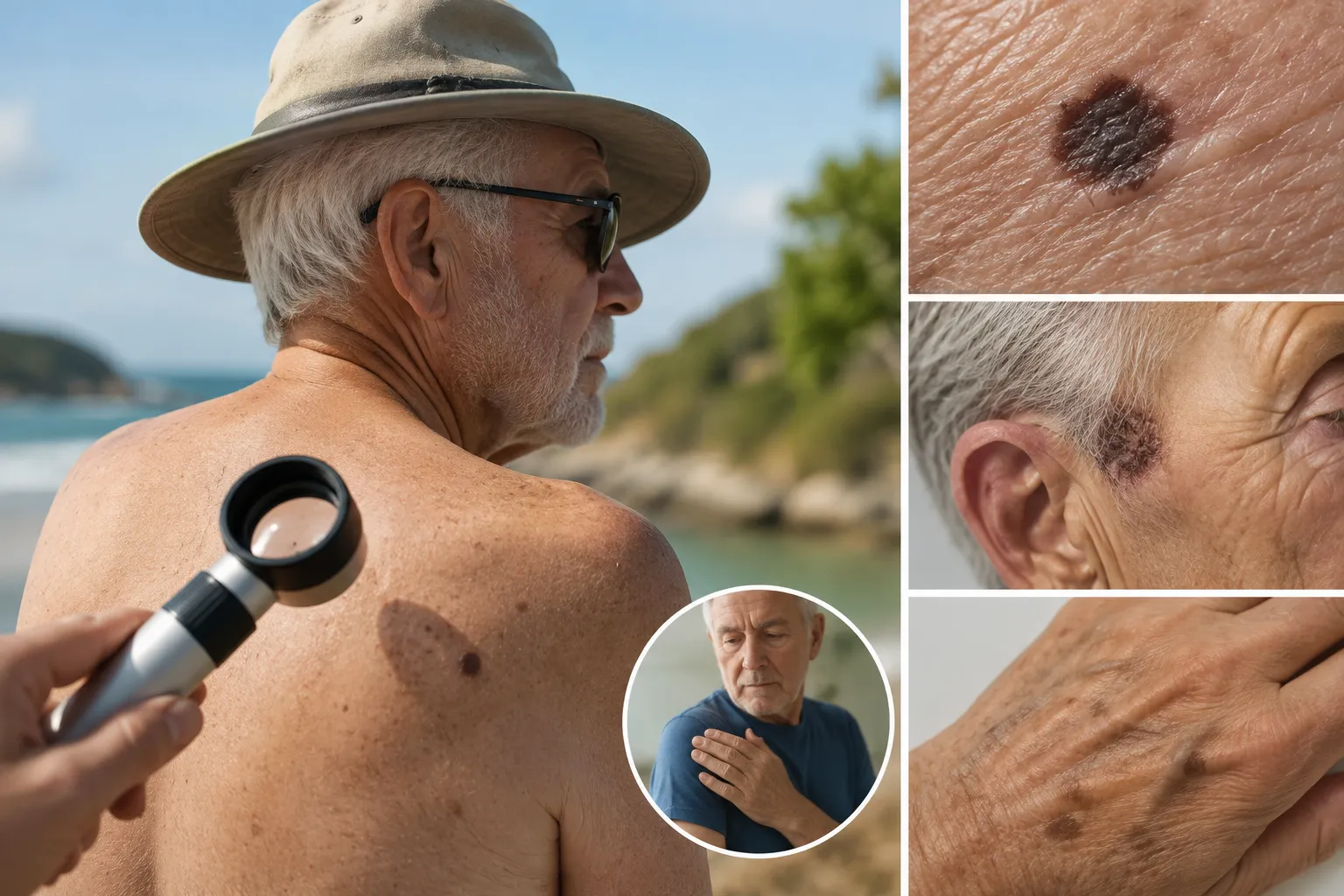
When was the last time anyone had a proper look at your back? Not a glance over your shoulder in the bathroom mirror, but an actual look.
Most people over 60 cannot answer that, and it matters more than it sounds. The skin back there has absorbed decades of Queensland sun and has no way of reporting in. Age thins the skin and slows down its repair work, so damage from the 70s and 80s finally starts showing up as spots, patches and growths, mostly harmless ones. The few that are not harmless look just as dull and forgettable as the rest in the beginning, and that is where the risk actually sits.
Key Takeaways
- Skin cancer risk increases with age, as decades of accumulated sun damage can begin appearing as new spots, rough patches, pigmentation, or growths after 60.
- Watch for changes in your skin, including new or rapidly growing spots, changing moles, bleeding or itchy lesions, persistent sores, and scaly or crusty patches.
- The ABCDE rule can help identify concerning moles, focusing on asymmetry, irregular borders, colour variation, larger diameter, and changes over time.
- Professional skin checks become increasingly important, particularly because some suspicious changes are difficult to see yourself, including areas such as the back, scalp, and backs of the legs.
- Annual skin checks are recommended for most people over 60, while those with significant sun damage or previous skin cancers may need more frequent examinations.
What Ageing Does to Your Skin
Ask anyone over 60, and they will tell you their skin does not bounce back the way it used to. Cuts sit around longer. Dry patches hang about through winter.
Behind that is the slow loss of collagen and elastin, which leaves the skin thinner and less able to look after itself. Thin skin also has less cover over the sun damage stored underneath it, so what was invisible at 45 begins surfacing as pigment, rough patches, or growths that were not on your arm last summer. Plenty of people put all of it down to getting older and leave it there.
You may also notice more freckles, age spots, or uneven pigmentation across your face, hands, and forearms, the areas that have typically caught the most sun. Most of these marks are harmless. Ageing skin also carries a higher chance of abnormal cell changes, which makes it harder to tell at a glance which spots are purely cosmetic and which deserve a closer look.
Why Skin Cancer Risk Climbs With Age
Australians in their 80s record the highest skin cancer rates of any age group, according to data compiled by the Australian Skin Cancer Foundation, and the rates rise sharply as people get older rather than settling. Sun damage from decades ago can take years to surface, which is exactly why your 60s and beyond call for more vigilance, not less.
Signs That Deserve a Closer Look
Nobody expects you to run to a clinic over every freckle. Some changes do warrant a closer look though, and these are the ones to keep track of:
- New spots appearing where there was not one before, especially if they grow quickly
- Changes to existing moles or freckles in size, shape, colour, or texture
- Spots that itch, bleed, or refuse to heal after a few weeks
- Scaly or crusty patches, or a sore that keeps coming back
- Asymmetry or uneven borders, particularly if one half of a mole looks different from the other
A simple way to remember this is the ABCDE rule: Asymmetry, Border irregularity, Colour variation, Diameter larger than a pencil eraser, and Evolving over time. If a spot ticks any of these boxes, have it checked at a skin cancer clinic rather than waiting to see what happens. Waiting rarely improves the outcome, and it often turns a small procedure into a larger one.
Why Professional Checks Matter More Now
A skin check never feels urgent, which is exactly why it slides down the list. Pain is not a reliable warning either because skin cancer does not always announce itself with discomfort, and the changes that matter most are often too subtle for anyone but a trained eye to pick up. A skin specialist knows what patterns to look for and has a clear view of the places you cannot inspect yourself properly, such as your back, scalp, and the backs of your legs.
Look at where the treatment actually happens. People aged 65 and over receive just over two-thirds of all non-melanoma skin cancer treatments in Australia, according to Cancer Council Australia. For anyone reading this in their 60s, that is not a warning about some distant stage of life. It is roughly now, and waiting until a spot changes is what puts most people in those figures.
If it has been a while since your last appointment, booking a professional skin check is a straightforward way to get peace of mind. A proper skin assessment involves a full-body examination by a trained professional, using tools that pick up changes long before they would be visible to the naked eye. It is a short appointment with a great deal riding on it.
Make Skin Checks Part of Your Yearly Routine
We usually suggest an annual appointment for patients over 60. If your skin is fair, if you carry a lot of sun damage, or if something has already been removed, we may want to see you more often than that.
The appointment itself is short, and the clinic will let you know if there is anything to do beforehand. Whatever the examination turns up, knowing it for certain beats guessing at it from the bathroom mirror.
Take someone with you if the idea makes you uneasy, and ask questions while the examination is happening because knowing what the melanoma specialist is looking at removes most of the mystery from it.
Your skin has done six decades of work and put up with plenty along the way. Twenty minutes of professional attention once a year is not fussing over yourself, it is the least dramatic way to stay ahead of whatever turns up.
Frequently Asked Questions
How often do I need a skin check once I am past 60?
Once a year works for most people over 60. If you have had skin cancers removed before, carry a lot of sun damage, or have several moles that look unusual, your clinician may recommend checking in more often.
Is a skin check painful?
No. It is a visual examination using specialised tools to look closely at your skin, and it is completely non-invasive. A full-body check usually takes around 15 to 20 minutes.
What happens if the clinician finds something?
Your clinician may recommend further tests, such as a biopsy, to examine the cells more closely. Many suspicious spots turn out to be harmless, though early testing is the safest way to know for certain.
Can skin cancer turn up on parts of the body that rarely see the sun?
Yes. Sun-exposed areas are more common sites, but skin cancer can develop anywhere on the body, including places rarely exposed to UV. This is why a full-body check matters more than checking only the areas you can see.
Does skin cancer behave differently in older adults?
It can be, because changes are sometimes more advanced by the time they are noticed on ageing skin. Regular checks help catch those changes earlier, when treatment is generally simpler.
