
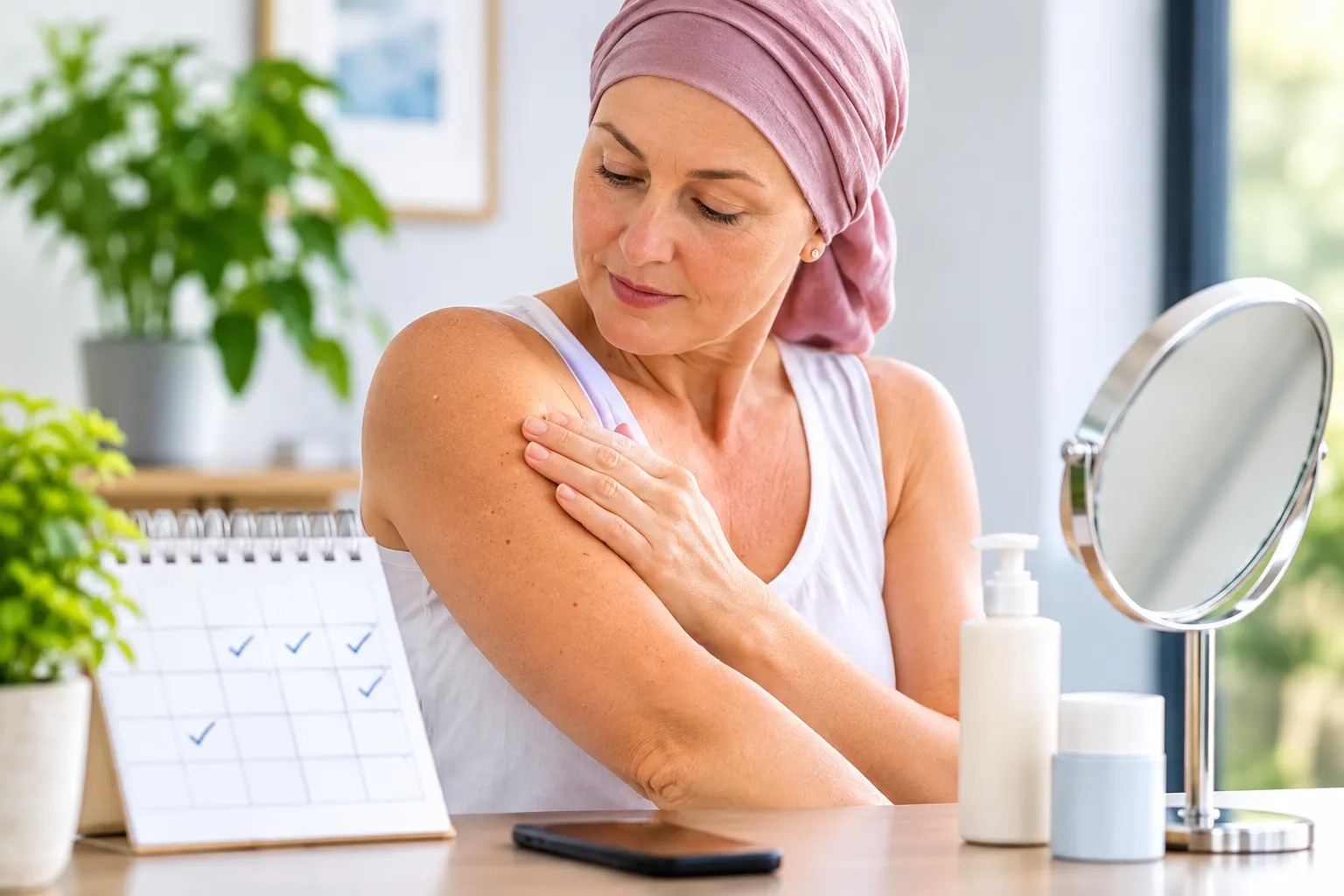
The end of skin cancer treatment brings a welcome sense of relief, along with a fair question about what comes next. Your skin still needs regular attention because a history of one skin cancer increases your chance of developing another.
Among the participants of an Australian study of more than 150,000 people, all first diagnosed with melanoma in New South Wales, 12.7% were later diagnosed with a second melanoma. That works out to about one in eight. With a steady, simple routine, you are far more likely to catch any new spot early, when treatment is at its easiest, and the steps below show you how to set one up.
Key Takeaways
- Continue regular skin checks after skin cancer treatment, as previous diagnosis can increase the risk of developing another skin cancer.
- Schedule follow-up appointments with your skin cancer doctor at the recommended intervals.
- Check your skin regularly for new spots or changes in existing moles, lesions or marks.
- Practise daily sun protection by using sunscreen, wearing protective clothing and seeking shade.
- Maintain a consistent monitoring routine and report suspicious changes promptly rather than waiting for your next scheduled appointment.
Schedule Professional Skin Checks on a Regular Basis
Self-checks matter, but a trained doctor with specialised tools can pick up changes that are easy to overlook at home. Your history decides how often you need to be checked. Many people return every three to six months during the first few years after treatment, then move to one or two visits a year. Your doctor will recommend a schedule based on your level of risk.
Non-melanoma skin cancers call for the same regular attention. Research from QIMR Berghofer points to a high rate of repeat treatment, with around half of Australian men treated for skin cancer needing another one removed within four years by the time they turn 70.
If you are local, book your Gold Coast skin checks at the same point each year, such as your birthday month or the start of summer, so they are easy to remember. Some clinics also offer full-body photography, which captures a detailed record of your skin and makes later changes simpler to compare.
Do a Head-to-Toe Self-Check Every Month
Monthly self-checks cover the time between your appointments. Pick a set day each month and add a reminder to your phone. Before you start, find a bright room, a full-length mirror and a hand mirror, then move through your body in this order:
- Face, ears, lips and scalp, with a comb or hair dryer to part your hair
- Neck, chest and stomach
- Arms, underarms, hands, fingernails and the skin between your fingers
- Back, buttocks and the backs of your legs, with the help of the hand mirror
- Legs, feet, soles, toenails and the skin between your toes
Pay close attention to your surgery scar as well. Watch for any new lump, redness or colour change around it.
Learn the Warning Signs to Watch For
The ABCDE guide gives you a simple way to assess any spot. Run through each letter as you check:
- Asymmetry: one half of the spot does not match the other
- Border: the edge looks irregular, blurry or jagged
- Colour: the spot has several shades, or a mix of brown, black, red, white or blue
- Diameter: the spot measures more than about 6 mm across, although melanomas can be smaller
- Evolving: the spot changes in size, shape, colour or feel
Keep an eye out as well for spots that bleed, itch or fail to heal, along with any ‘ugly duckling’ that stands out from your other moles. Non-melanoma skin cancers often appear as a scaly patch, a pearly lump or a sore that keeps returning.
Track Your Spots With Photos and Notes
Memory is not a reliable way to track how a mole changes over time. Photograph any spots you are watching, and place a ruler or coin next to each one for scale. Save the images to a separate album on your phone so you can compare them each month. Record the date and the body location for every photo, and bring the album along to your appointments.
Shield Your Skin From UV Year-Round
Sun protection remains part of daily life after treatment. Apply SPF 50+ sunscreen, and add a broad-brimmed hat, sunglasses and clothing that covers your skin. Stay in the shade between 10 am and 3 pm. Check the UV index each day, as Queensland levels are often high enough to burn even in winter. Avoid solariums completely.
Know Who to Call When Something Changes
Save your doctor’s contact details somewhere easy to find. If a new spot appears or an existing one changes, contact your clinic and ask for an earlier appointment rather than waiting for your next scheduled check. If you have had melanoma, ongoing contact with melanoma treatment specialists who know your history means any change is measured against what is normal for you.
Care for Your Mind as Well as Your Skin
Worry about skin cancer returning is a common experience after treatment. Your GP, a counsellor or a support group can help you work through those feelings. A clear monitoring routine also eases the worry, as it gives you something concrete to focus on.
Set Up Your Skin Monitoring Routine Today
Few things do more for your long-term health than a regular monitoring routine. If your last check was a while ago, or you are unsure how often you should be seen, book an appointment with our team today.
Common Questions About Life After Skin Cancer Treatment
How often should I have a skin check after skin cancer treatment?
The right frequency depends on the type of skin cancer you had and your individual risk. Many people are seen every 3 to 6 months during the first few years after treatment, then 1 to 2 times a year after that. Your doctor will set a timetable around your history.
How often should I check my own skin?
A monthly self-check is ideal. Choose the same day each month, use bright light and two mirrors, and examine your entire body, including your scalp, the soles of your feet and between your toes. Take photos of any spots you are monitoring to make it easier to compare them over time.
What changes should I report straight away?
Report any new spot, or any mole that changes in size, shape or colour. Spots that bleed, itch, crust or fail to heal within a few weeks also need attention, and so does any lump that appears near your scar. Call your clinic as soon as you notice one of these signs so a doctor can take a look sooner.
Can skin cancer come back after treatment?
Yes, it can. Skin cancer may return in the same area, and a previous skin cancer also increases your chance of a new one developing elsewhere on your body. Regular professional checks and monthly self-checks improve the odds that any new cancer is picked up early, while it is still simplest to treat.
Is full-body photography worth it?
For many people, it is, particularly those with a large number of moles or a history of melanoma. Full-body photography produces a detailed record of your skin, which helps your doctor identify new or changing moles at each appointment. Ask our team whether it is a good fit for you.
