
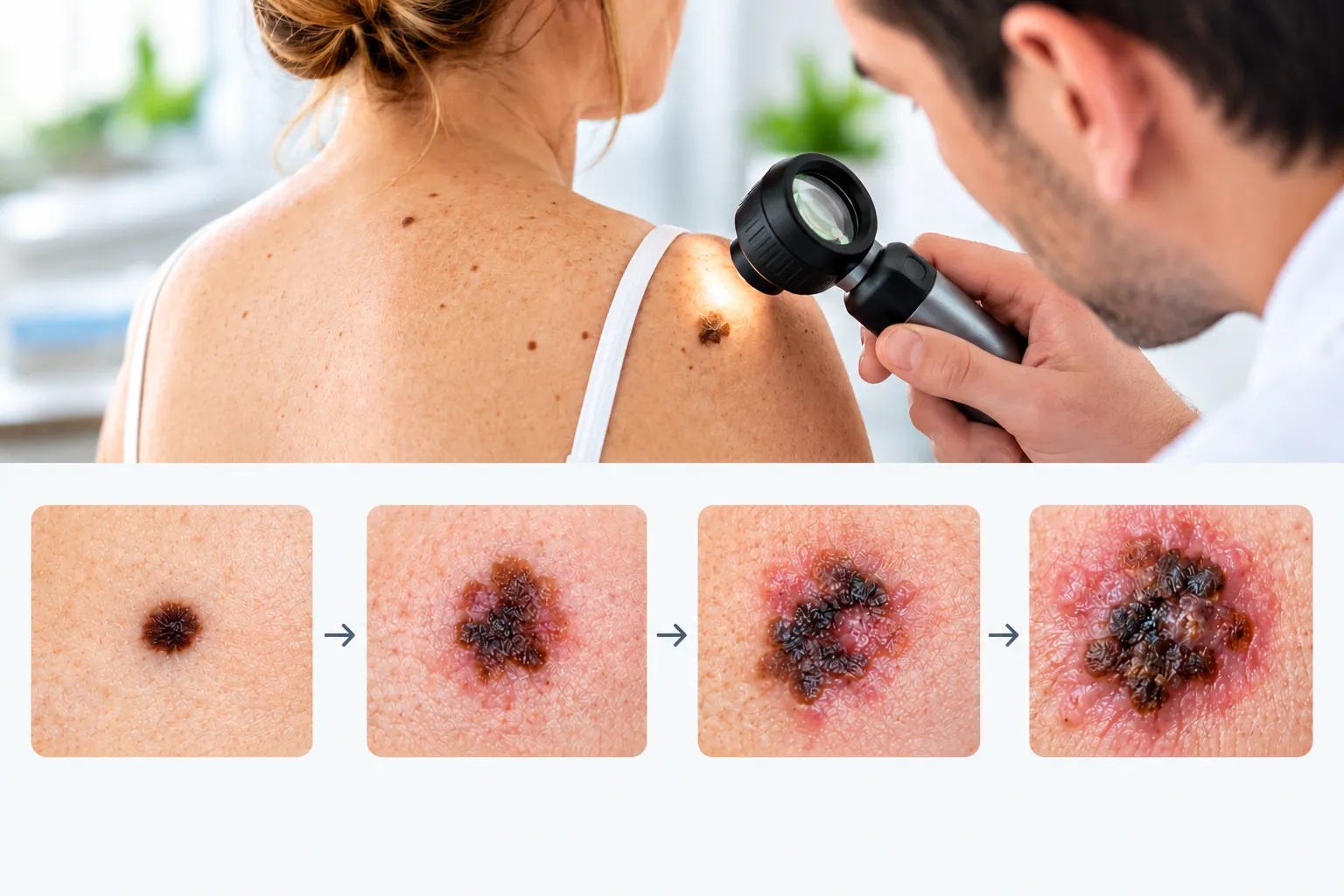
A skin cancer diagnosis is hard enough to hear. When a doctor adds a number to it, such as stage 1 or stage 4, the news can feel even harder to make sense of. This guide explains what those numbers mean, how stage 1 skin cancer compares with stage 4 skin cancer, and why the stage at which a melanoma is found has such a strong bearing on treatment and recovery.
Key Takeaways
- Stage 1 skin cancer is generally localised, meaning the cancer is small and has not spread to distant parts of the body.
- Stage 4 represents advanced disease, where cancer has spread to distant organs, lymph nodes or other tissues, depending on the cancer type.
- Staging depends on several factors, including tumour size, depth, lymph node involvement and whether the cancer has spread.
- Treatment options vary by stage and cancer type, potentially including surgery, radiotherapy, immunotherapy or targeted therapies for advanced cases.
- Early detection can improve treatment outcomes, making regular skin checks and prompt medical assessment of changing or suspicious spots important.
How Skin Cancer Staging Works
Doctors stage a cancer to describe how far it has grown and whether it has spread from where it first appeared. The stage helps your medical team decide on treatment, and it also gives you a clearer sense of what to expect.
Melanoma, the most serious form of skin cancer, is the type staged most often. Basal cell carcinoma and squamous cell carcinoma are far more common but rarely spread, although a squamous cell carcinoma may be staged if it is large or behaving aggressively. To work out a melanoma’s stage, doctors assess four main factors:
- Thickness: the depth the cancer has reached in the skin, measured in millimetres
- Ulceration: whether the skin covering the spot has broken down
- Lymph nodes: whether cancer cells have reached the small glands that filter fluid draining from the skin
- Spread: whether the cancer has moved to other parts of the body
Melanoma stages run from 0 to 4. At stage 0, the cancer sits only in the outermost layer of skin.
Stage 1: Early, Contained and Highly Treatable
Stage 1 melanoma is early-stage skin cancer. The tumour is thin, generally no deeper than 1 to 2 millimetres, and it has not reached the lymph nodes or any other part of the body.
Treatment at this stage is usually straightforward. In most cases, a minor surgical procedure removes the spot together with a small margin of healthy skin, often under local anaesthetic. Some patients also have a lymph node test to confirm the cancer has not spread. Ongoing care after that mostly involves regular skin checks.
The outlook is very good. According to Cancer Australia, people diagnosed with stage 1 melanoma had a five-year relative survival rate of at least 99%, compared with 26% for stage 4. Those figures relate to melanomas diagnosed in 2011, and treatment for advanced disease has progressed since then, but the gap between the two stages shows how much timing matters.
Stages 2 and 3: Thicker Growth and Nearby Spread
A stage 2 melanoma is thicker or ulcerated, yet it remains confined to the skin. By stage 3, cancer cells have travelled to nearby lymph nodes or to skin close to the original spot. Treatment becomes more complex at this point and can include wider surgery, removal of lymph nodes and medicines that reduce the risk of the cancer coming back.
Stage 4: When Melanoma Reaches Distant Organs
Stage 4 is late-stage skin cancer. Here, the melanoma has spread through the bloodstream or lymphatic system to distant parts of the body, such as the lungs, liver, brain or bones.
A melanoma specialist and their team manage treatment, which may combine immunotherapy (medicine that helps your immune system attack the cancer), targeted therapy, radiation and surgery. These options have improved outcomes for many people over the past decade, and some now live for years after diagnosis. Even so, late-stage skin cancer is much more difficult to treat than a spot caught early.
Most Melanomas Are Now Found Early
Recent figures bring encouraging news about early diagnosis. In Victoria, stage 1 made up 70% of new melanoma diagnoses in men and 77% in women in 2024. Figures like these point to the value of noticing changes in your skin and having them checked promptly.
The signs to look out for include spots that are new, that change in size, shape or colour, that bleed or itch, or that simply look different from your other moles. The ABCDE rule is a helpful guide: Asymmetry, an irregular Border, more than one Colour, a Diameter larger than 6 millimetres, and Evolving, which means any change over time. If a spot concerns you, book an appointment straight away rather than waiting for your next routine check.
Book a Skin Check Before a Spot Moves Past Stage 1
Melanoma can grow quickly, and areas such as your back, scalp and the backs of your legs are difficult to see on your own. A professional examination with a dermatoscope, a magnifying light that reveals patterns beneath the skin’s surface, can detect changes well before they become obvious. A full check is painless, needs no preparation and generally takes 15 to 30 minutes.
Regular Gold Coast skin cancer checks give you the strongest chance of finding a problem at stage 0 or 1, when treatment is simple. At our Gold Coast skin clinic, we provide thorough head-to-toe checks in a relaxed setting and explain each step as we go. This article offers general information only and is not medical advice, so please speak with a doctor about your own circumstances.
Your Skin Cancer Staging Questions Answered
What is the difference between stage 1 and stage 4 skin cancer?
Stage 1 melanoma is thin and has not spread past the skin, while stage 4 melanoma has reached distant organs such as the lungs, liver or brain. A stage 1 melanoma is generally treated with minor surgery, whereas stage 4 requires care from a melanoma specialist.
Is stage 1 skin cancer curable?
In most cases, yes. Minor surgery usually removes a stage 1 melanoma completely, and long-term survival rates are very high. Regular skin checks are still needed afterwards, because a person who has had one melanoma faces a higher risk of developing another.
How quickly can skin cancer progress from one stage to another?
The pace varies. Some melanomas develop slowly over months or years, while others, including nodular melanoma, can grow within weeks. For this reason, any new or changing spot should be checked promptly instead of being left until your next scheduled appointment.
How do doctors work out the stage of skin cancer?
Once the spot is removed, a pathologist measures its thickness and looks for ulceration. Your doctor may also test nearby lymph nodes or arrange scans to find out whether the cancer has spread. Taken together, these results determine the stage.
How often should I get a skin check?
A yearly professional skin check suits most adults. If you have many moles, fair skin, a history of skin cancer or a family history of melanoma, you may need a check every 3 to 6 months. Your doctor can advise on the right schedule for you.
