
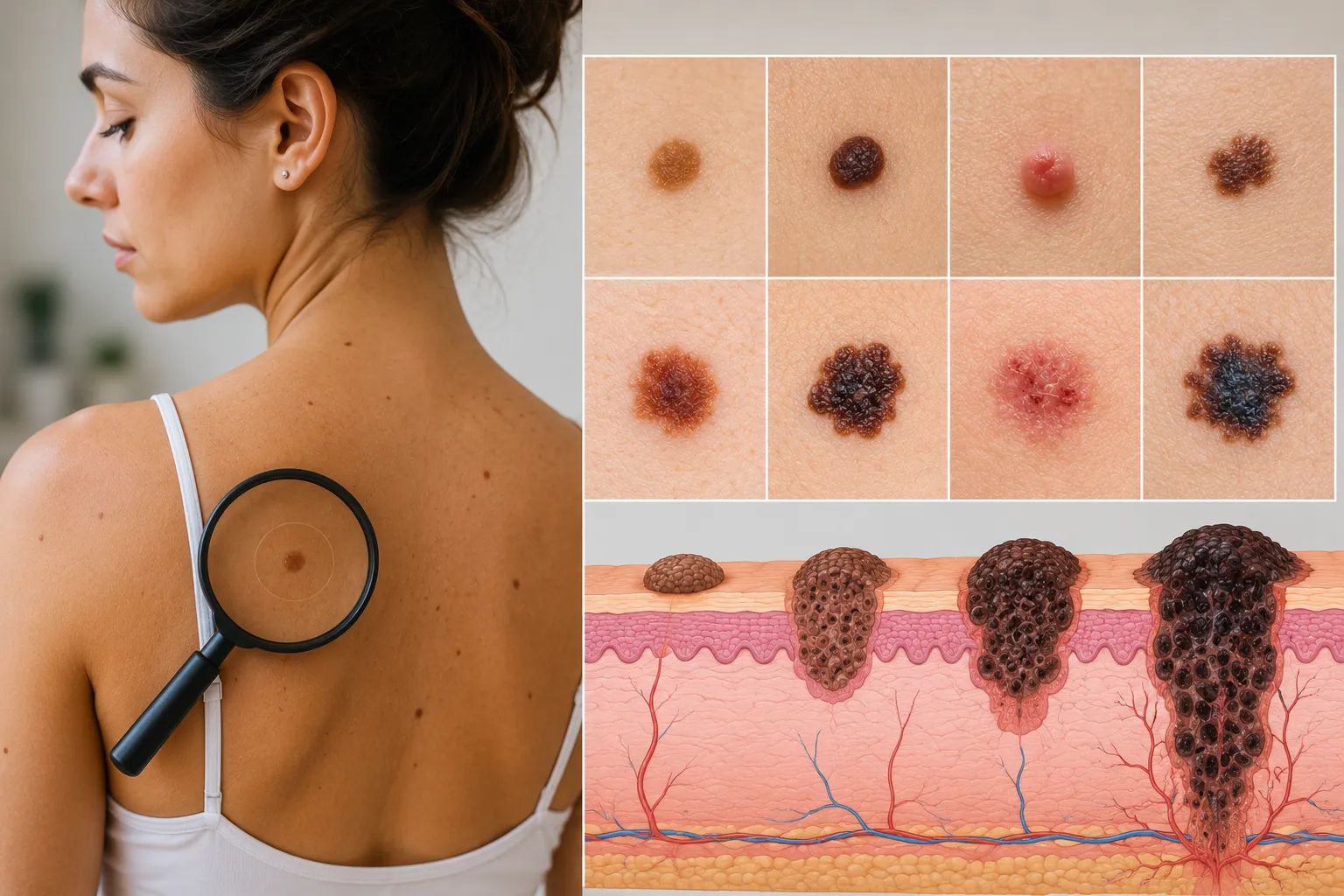
Skin cancer is one of the most common cancers in Australia, yet a surprisingly large number of cases still go undetected for far too long. It is not always because people are not looking. Often, it is because they are not looking for the right signs.
Most people picture skin cancer as a dark, irregular spot that obviously announces itself. In reality, some types blend so easily with everyday bumps and blemishes that they assume the mark is nothing to worry about. That is how skin cancers that could have been caught early are missed.
Key Takeaways
- Not all skin cancers look alarming: Many skin cancers resemble harmless pimples, rashes, dry skin, or small bumps, making them easy to overlook and delaying diagnosis.
- The ABCDE rule has limitations: While useful for identifying many melanomas, some aggressive skin cancers do not display the typical signs of asymmetry, irregular borders, colour variation, or large size.
- Certain melanomas can be difficult to spot: Amelanotic melanoma may appear pink, red, or skin-coloured rather than dark, while nodular melanoma is often symmetrical, uniformly coloured, and grows downward into the skin.
- Common skin cancers can appear harmless: Basal cell carcinoma may look like a shiny bump or persistent sore, while squamous cell carcinoma can resemble eczema, a wart, or a recurring scaly patch.
- Watch for anything unusual or persistent: Any new, growing, changing, or non-healing spot should be assessed by a professional, as early detection significantly improves treatment outcomes.
Why We Spot the Wrong Warning Signs
Almost every skin cancer awareness campaign in Australia has been built around the ABCDE framework: asymmetry, border irregularity, colour variation, diameter, and evolution. It works well for superficial spreading melanoma, which creeps outward across the skin in uneven, multicoloured patches that are hard to miss once you know what to look for.
The trouble is, some of the most aggressive types do not tick any of the ABCDE signs. That is exactly what keeps them undetected for so long and why the ABCDE rule is a useful starting point, but not the complete picture.
The Melanoma That Hides Without Pigment
Melanin gives skin its pigment, and most melanomas produce enough of it to appear as a dark, visibly discoloured mark. Amelanotic melanoma throws that assumption out entirely. It produces little to no melanin, so instead of appearing dark, it appears as a pink, red, or skin-toned mark that blends easily into the surrounding tissue.
Most people see it as a pimple, an ingrown hair, or a minor irritation, and wait for it to settle down on its own. Because it lacks the visual cues that prompt concern, amelanotic melanoma is often diagnosed later than pigmented melanoma, giving it more time to invade deeper layers of skin before you can take action.
Why Nodular Melanoma Slips Past the Checklist
Nodular melanoma behaves differently from almost every other subtype. Rather than spreading across the surface, it grows into the skin from the start, reaching a dangerous depth of invasion faster than other melanoma types. How unremarkable it looks on the surface is what makes it particularly difficult to catch.
Research published in the Royal Australian College of General Practitioners found that 80% of nodular melanomas were symmetrical, 78% presented in a single colour with a regular border, and 55% produced no pigment. That profile rules it out of nearly every visual warning sign Australians are taught to watch for. In cases like this, a melanoma specialist relies on the EFG framework: Elevated, Firm, and Growing for more than a month.
Basal Cell Carcinoma: The Bump That Looks Harmless
Basal cell carcinoma is one of the skin cancers that can look completely harmless. It presents as a small, shiny, pearly bump with fine blood vessels on its surface, or a flat, pinkish area that refuses to heal. Its slow growth and minimal discomfort give most people every reason to ignore it, and that decision tends to backfire.
Over time, basal cell carcinoma can burrow into surrounding tissue, including nerves and bone in some cases, turning what could have been a straightforward early removal into a significantly more involved procedure.
Squamous Cell Carcinoma: The Scaly Patch That Won’t Stop Returning
Squamous cell carcinoma has a habit of showing up exactly where people least expect a cancer to be hiding. It appears as a scaly, thickened, or crusted lesion that sometimes bleeds easily when knocked, most commonly develops in areas with years of sun exposure, and sometimes occurs inside the mouth.
It mimics the appearance of a wart, eczema, or stubborn dry skin, which is why people tend to treat it with a moisturiser or an antifungal cream instead of getting it checked. Cancer Council Australia notes that basal cell carcinoma and squamous cell carcinoma together account for around 98% of all skin cancer diagnosed in the country. That figure alone makes deceptively harmless-looking cancers one of the common reasons Australians visit a doctor each year.
What to Actually Watch For on Your Skin
Home skin checks are worth doing, but only if they are guided by an accurate picture of what skin cancer can actually look like. A meaningful check means paying attention to any pimple or sore that refuses to heal, a bump that changes in height, shape, or colour, or a mark that simply will not go away. None of these descriptions sounds like cancer, which is exactly the problem.
A professional skin check adds something no mirror check can replicate. A trained eye familiar with every presentation, not just the obvious ones, combined with dermatoscopy, which reveals what the naked eye cannot reach, gives you a far clearer picture of what is really going on.
Get Anything Unusual Checked, Always
Some of the skin cancers that cause the most harm are not the ones that announce themselves. The most dangerous types are those pretending to look like a normal skin patch, and that is exactly what makes them so hard to catch. It is a fundamental part of how they survive long enough to become a serious problem.
If something on your skin is new, growing, or not resolving on its own, do not wait for it to become more concerning before taking action. Book a consultation at a trusted skin cancer clinic to understand what you are dealing with before it gets worse.
